

The Label Says "Compostable." That Doesn't Tell You Much.
Walk down the packaging aisle of any restaurant supply distributor and you'll find forks, cups, and lids stamped with green leaves and the word "compostable." Almost none of the brands explain what that actually means — under what conditions, at what temperature, in how many weeks, and what happens if the packaging ends up somewhere other than an industrial composting facility.
For a Sustainability Director trying to make defensible claims and avoid greenwashing liability, that vagueness is a problem. The science of biodegradation isn't complicated, but it's precise — and the difference between a product that genuinely returns to nature and one that persists in the environment for decades comes down to molecular chemistry and microbial biology.
This post covers exactly how compostable packaging biodegrades at a scientific level, what distinguishes truly compostable materials from misleadingly labeled ones, how PHA and PLA break down differently (and why that gap matters enormously), what happens in each end-of-life environment, and what certifications actually verify. We'll also address the microplastics question directly — because the answer is not the same for every "compostable" material on the market.
What Biodegradation Actually Is: The Molecular and Microbial Process
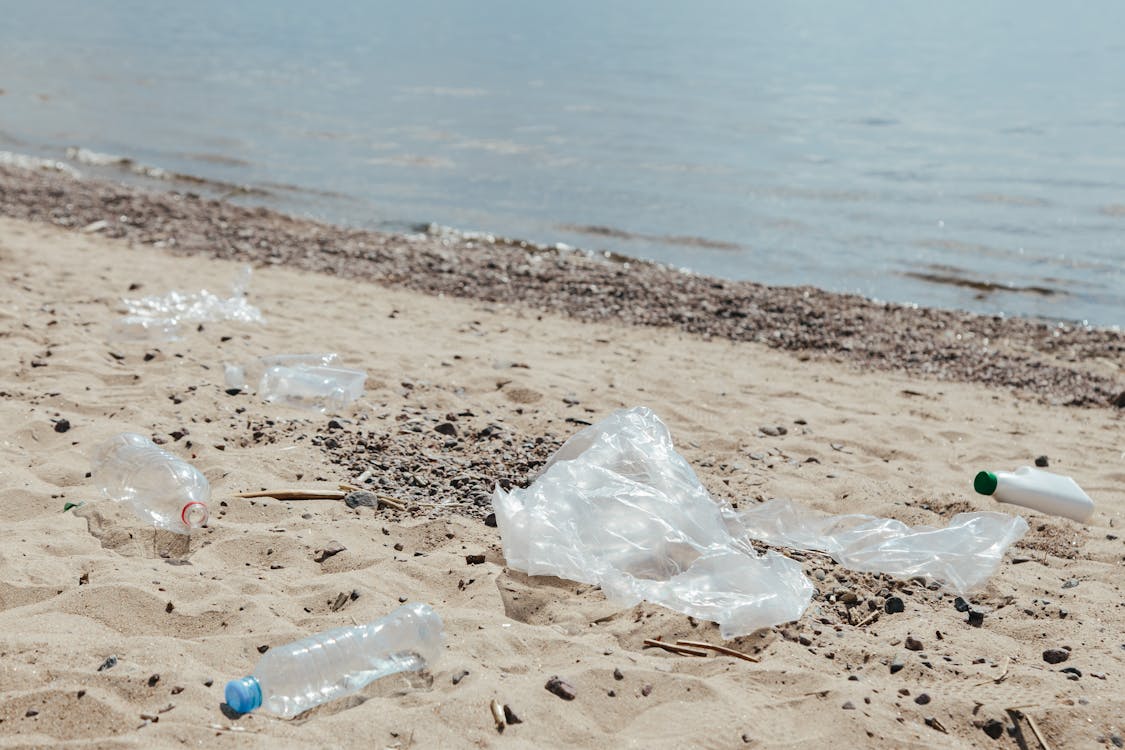
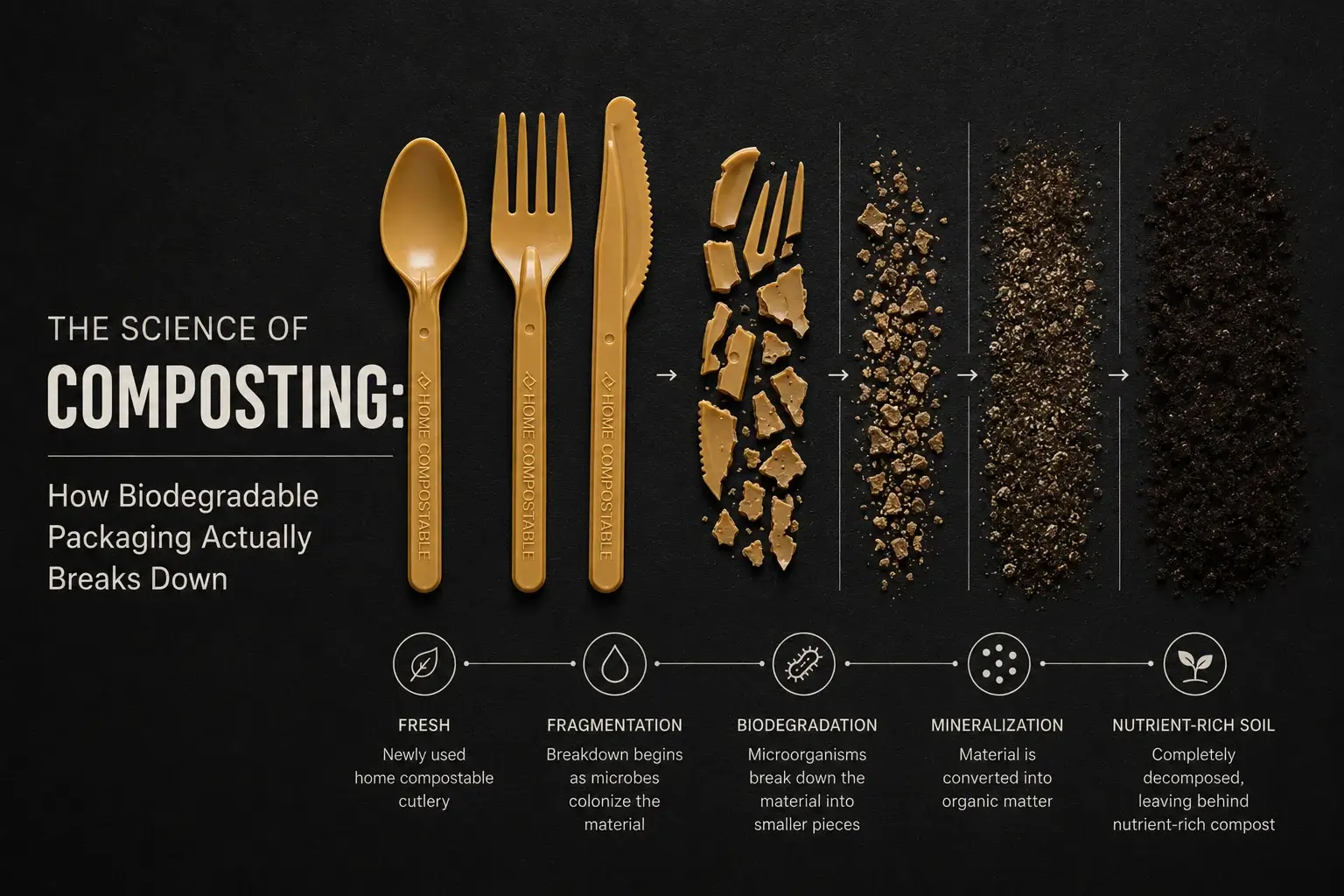
Biodegradation is not the same as falling apart. A plastic bag that fragments under UV light into thousands of tiny pieces is not biodegrading — it's becoming microplastics. True biodegradation is a biological process in which living microorganisms break down a material's polymer chains into their molecular building blocks, which are then metabolized into carbon dioxide, water, and biomass.
Research published in Frontiers in Microbiology describes the four-stage process:
- Biodeterioration — Microorganisms colonize the material surface, beginning to alter its mechanical, physical, and chemical properties through enzymatic and mechanical action.
- Biofragmentation — Extracellular enzymes secreted by microbes (hydrolases, depolymerases, esterases) attack the polymer chains, cleaving ester or other bonds and breaking large molecules into shorter oligomers, dimers, and monomers.
- Bioassimilation — These smaller fragments — now small enough to cross cell membranes — are absorbed by microbial cells and used as carbon and energy sources.
- Mineralization — Inside the cell, the absorbed compounds are fully converted to CO₂ and water under aerobic conditions (or CO₂, water, and methane under anaerobic conditions), with new microbial biomass as a byproduct.
The critical factor determining whether a material actually biodegrades — rather than merely persisting as fragments — is whether microorganisms in that specific environment possess enzymes capable of attacking the polymer's chemical structure. According to the American Society for Microbiology, biodegradable plastics typically contain ester groups in their backbone (–RCOOR–), which are susceptible to enzymatic attack by esterases, lipases, cutinases, and depolymerases. Conventional petroleum plastics, by contrast, are built from hydrocarbon chains with few or no functional groups that microbial enzymes can act on — which is why they persist in the environment for centuries.
Polymer crystallinity matters too. Studies on polymer degradation confirm that microbial enzymes preferentially attack the amorphous (disordered) regions of polymer chains. Highly crystalline materials degrade more slowly because the densely packed molecular structure is harder for enzymes to penetrate. This is directly relevant to PLA versus PHA — and we'll return to it.
Biodegradable vs. Compostable vs. Degradable: The Distinctions That Matter
These three terms get used interchangeably in marketing. They are not interchangeable. The Biodegradable Products Institute draws the line clearly:
Degradable — Almost everything is technically degradable given enough time. The term carries no time limit, no requirement for biological activity, and no safety standard for end products. Oxo-degradable plastics, for example, fragment under UV or mechanical stress into microplastics but never fully biodegrade — microorganisms don't recognize their synthetic monomers as food. According to Green Dot Bioplastics, oxo-degradable plastics "fragment into smaller and smaller pieces, called microplastics, but don't break down at the molecular or polymer level." The EU has banned oxo-degradable packaging entirely.
Biodegradable — Technically accurate when microorganisms can break down the material, but the term is unregulated in a marketing context. It specifies neither timeframe nor environment. A product labeled "biodegradable" could persist for 30 years in soil and still meet the technical definition. The FTC's Green Guides state that unqualified biodegradable claims are deceptive for items entering solid waste streams if they don't completely decompose within one year. Many items on the market, including some PLA products, carry "biodegradable" labels without meeting any regulated timeframe standard.
Compostable — This is the only term backed by defined, testable standards. Per ASTM and EN 13432 requirements, a certified compostable material must: biodegrade at least 90% within 180 days under specified composting conditions; physically disintegrate so no fragments larger than 2mm remain after 12 weeks; and leave no toxic residues that harm plant growth. All compostable materials are biodegradable, but not all biodegradable materials are compostable — the compostable designation requires third-party verification against specific, regulated standards.
The further distinction — and this is where most brands get into trouble — is the difference between industrially compostable and home compostable. Industrial certification (ASTM D6400, EN 13432) only guarantees biodegradation at the controlled high temperatures of a commercial composting facility. Home compostable certification requires biodegradation at ambient temperatures, which is a fundamentally higher bar.
For a deeper look at how these distinctions play out in real product sourcing decisions, see PHA vs. PLA: The Definitive Guide to Choosing Compostable Packaging.
How PHA Biodegrades: Biology Built Into the Material
PHA (polyhydroxyalkanoates) is, quite literally, produced by biology — and that origin is why it biodegrades so reliably in biological environments.
Bacteria produce PHA as an intracellular energy reserve, accumulating polymer granules inside their cells when carbon sources are abundant but other nutrients are limited. Research published in Nature explains that PHA is biosynthesized through a metabolic pathway beginning with acetyl-CoA, the basic unit of cellular metabolism. The result is a polyester whose molecular structure is natively recognized by the microbial world — because it was made by that world.
The Enzymatic Mechanism
When PHA enters an environment containing microbial life — soil, compost, freshwater, seawater — bacteria and fungi produce extracellular PHA depolymerases (EC 3.1.1.75 and EC 3.1.1.76). These specialized enzymes adsorb onto the polymer surface and catalyze hydrolysis of the ester bonds in the PHA chain. A 2025 review in Frontiers in Microbiology describes the process:
- Extracellular PHA depolymerases hydrolyze the ester bonds, cleaving the polymer into oligomers and monomers (primarily hydroxyalkanoic acids)
- These water-soluble monomers are transported across bacterial cell membranes
- Inside the cell, the monomers enter the beta-oxidation pathway and then the tricarboxylic acid (TCA or Krebs) cycle, yielding energy, CO₂, and water
- Under anaerobic conditions, the same pathway generates CO₂ and methane
The key feature: PHA-degrading bacteria are found distributed throughout virtually every ecosystem on Earth — soil, compost, freshwater, marine sediments, shallow coastal waters, and deep-sea environments. Genera including Bacillus, Pseudomonas, Comamonas, Cupriavidus, Alcaligenes, Enterobacter, and Gracilibacillus have all been identified as active PHA degraders in different environments. PHA depolymerases work across a wide temperature range — documented at 10–42°C — which is why PHA degrades at ambient temperatures without requiring industrial heat.
This breadth of microbial recognition is the decisive difference between PHA and every other packaging material on the market. The polymer exists within the natural carbon cycle. When it enters an environment, microorganisms recognize it — because they made it, and their enzymes evolved to process it.
What Happens to PHA Microparticles
When PHA degrades, it does not generate stable microplastic residues. A comprehensive 2025 review published in Biodegradation confirms: "the composition and microstructure of PHA biopolyesters was fine-tuned by Nature in a way to make them biodegradable by Nature's biocatalytic toolbox; thus, upon biodegradation no PHA microparticles (MP) are left in the environment." Any fragments that form during surface erosion are themselves substrates for microbial depolymerases — the degradation cascade continues down to complete mineralization.
How PLA Breaks Down: An Industrial Chemical Process
PLA (polylactic acid) is produced through an entirely different mechanism — industrial chemical synthesis. Lactic acid monomers derived from fermented corn or sugarcane starch are chemically linked into long polymer chains through a process requiring catalysts and controlled reaction conditions. The resulting polymer has no native microbial recognition; it requires a two-step abiotic-then-biotic process to break down.
Step 1: Hydrolysis (Requires Heat)
PLA does not biodegrade directly through enzymatic attack. It first requires abiotic hydrolysis — a chemical process in which water molecules break the ester bonds in the polymer chains, reducing molecular weight. Research published in the Royal Society of Chemistry confirms: "PLA is a biodegradable material, but only under elevated temperatures (>55 °C)." This temperature requirement is tied to PLA's glass transition temperature (Tg) — approximately 55–60°C — the point at which the polymer becomes amorphous and accessible to hydrolysis. Below that temperature, PLA's crystalline structure resists both water penetration and enzymatic attack.
A peer-reviewed study on PLA biodegradation at varying temperatures found: - At 58°C (industrial composting): 92.3% mineralization within 119 days - At 37°C: only 19.5% mineralization - At 25°C (home composting / ambient): only 14.9% mineralization
Step 2: Microbial Uptake (Only After Sufficient Hydrolysis)
After hydrolysis reduces molecular weight below ~10,000 g/mol, soil microorganisms can begin metabolizing the lactic acid oligomers. But this threshold matters — at higher molecular weights, the fragments are too large for microbial uptake, and they simply persist in the environment as intermediate-stage fragments. Industrial composting facilities must sustain thermophilic temperatures (55–60°C) for a sufficient duration to push hydrolysis far enough to enable subsequent microbial metabolism.
This two-step dependency on industrial conditions — heat for hydrolysis, then microbial uptake — is why PLA fails to biodegrade in home composts, soil, and marine environments. It is not a biodegradable material in any environment that lacks sustained elevated heat.
The Marine Data
The most cited evidence is a peer-reviewed study published in PLOS ONE by researchers at the Scripps Institution of Oceanography, who submerged PLA samples alongside conventional petroleum plastics in coastal seawater for 428 days. The result: PLA showed zero measurable degradation — chemically indistinguishable from petroleum-based polypropylene and PET after 14 months. As SciTechDaily summarized the findings, "compostability does not imply environmental degradation."
The Four Environments: What Each Requires
Understanding how different environments enable — or block — biodegradation is essential for making credible claims about packaging end-of-life.
EnvironmentConditionsPHA Biodegrades?PLA Biodegrades?Industrial Composting55–65°C, controlled humidity, regular aeration, managed microbial load✅ Yes — fully in 12 weeks✅ Yes — requires sustained 55–60°C for 90–180 daysHome Composting20–30°C ambient, variable moisture, lower microbial density✅ Yes — ~7 weeks under favorable conditions❌ No — less than 15% mineralization at 25°CSoilAmbient temps, variable moisture and microbial populations✅ Yes — through ubiquitous PHA depolymerase-producing bacteria❌ No — can persist up to 30 yearsMarine / FreshwaterCold seawater, varied salinity, UV exposure at surface✅ Yes — PHA-degrading bacteria present in coastal, shallow, and deep-sea environments❌ No — zero degradation after 428 days in peer-reviewed marine study
Industrial composting operates at 55–65°C with controlled humidity (around 60%) and high microbial loads. AIMPLAS notes that industrial facilities achieve thermophilic conditions that home piles cannot sustain due to lower mass and heat losses. These conditions are necessary for PLA but are more than sufficient for PHA — which also processes cleanly through industrial facilities.
Home composting operates at typical ambient temperatures of 20–30°C with less consistent aeration and moisture. According to Good Start Packaging, home composting conditions rarely exceed the temperatures needed for PLA to initiate hydrolysis. Products certified as home compostable must demonstrate full breakdown at these lower temperatures, which PHA achieves through its native microbial recognition.
Soil and open environments represent the real-world test for any "biodegradable" claim. PHA-degrading microorganisms are documented throughout terrestrial soils globally. PLA, stripped of industrial heat, can persist in soil for decades — behaving functionally like a conventional plastic for environmental purposes.
Marine and freshwater environments are where the performance gap is most consequential. Packaging escapes designed end-of-life pathways constantly. A material that only biodegrades in one specific, infrastructure-dependent environment provides no safety net for that inevitable leakage. PHA has been documented as biodegradable across coastal, shallow-water, and deep-sea marine environments, with PHA-degrading bacteria present throughout the ocean. The GOPHA research review estimated PHA biodegrades in marine environments at 0.04–0.09 mg/day/cm², meaning a thin PHA bag could be expected to fully biodegrade within 25 days to two months.
For a full analysis of how composting environments compare and which facilities actually accept which materials, see Industrial vs. Home Composting: What's the Difference?.
The Microplastics Question
"Compostable" packaging is sometimes assumed to be automatically free of microplastic risk. It isn't — at least not for all materials.
Microplastics form when plastic items fragment but the resulting particles are not biologically mineralized. Whether a material generates persistent microplastics depends entirely on whether the fragments it produces continue to be recognized and metabolized by microorganisms in that environment.
PLA and microplastics: When PLA fragments in environments lacking industrial heat — along roadsides, in waterways, on beaches — those fragments are chemically stable in the absence of sufficient temperatures to drive hydrolysis. Research on PLA microplastics has investigated their ecotoxicity in marine organisms. The fragments persist because the conditions required for breakdown — sustained 55–60°C — are not met. PLA microplastics in cold marine or soil environments are functionally equivalent to conventional petroleum plastic microplastics: stable, non-metabolized, and bioaccumulating.
PHA and microplastics: PHA's situation is fundamentally different. Even when PHA fragments, those fragments remain substrates for PHA depolymerases in soil and water. The Biodegradation review explicitly confirms that PHA biodegradation leaves no microplastic residues — the enzymatic cascade continues to complete mineralization regardless of fragment size. Research cited in the same review confirmed that even spherical PHA microbeads (analogous to the microplastics found in conventional cosmetics) biodegraded measurably in marine environments within 60 days. There is no "stable intermediate" in PHA's environmental fate — the biological machinery to complete degradation exists everywhere PHA-degrading bacteria exist, which is essentially everywhere.
This is one of the most consequential differences in the compostable packaging market: PHA is the only widely available packaging material where the "no microplastics" claim is scientifically defensible across environments. For a detailed comparison, see Microplastics: PLA vs. PHA.
Certification Standards Explained
Certification is the mechanism through which biodegradation claims are independently verified. Understanding what each standard tests — and what it doesn't — is essential for building defensible sustainability claims.
CertificationStandardScopeTesting ConditionsWhat It VerifiesBPI / ASTM D6400ASTM D6400Industrial compostable plastics (US/Canada)55–60°C, 180 days, 90% biodegradationIndustrial compostability of finished product; no home composting, soil, or marineASTM D6868ASTM D6868Coated paper and fiber products with bioplastic liners (US)Same as D6400 for both substrate and coatingEntire product (paper + coating) must biodegrade; catches products where the fiber passes but the liner doesn'tEN 13432European Norm 13432Industrial compostable packaging (EU)55–60°C, 180 days, 90% biodegradation, <2mm fragments in 12 weeks, ecotoxicity testingIndustrial compostability; legally required in EU for "compostable" labels; issued by TÜV Austria or DIN CERTCOTÜV OK Compost HOMETÜV AustriaHome compostable (EU and internationally recognized)20–30°C, 12 months, full biodegradation, no toxic residuesHome compostability — the highest bar for real-world biodegradation; no industrial conditions requiredUSDA Certified BiobasedUSDA BioPreferredBio-based content (US)Carbon-14 isotope analysisPercentage of product made from biological (not petroleum) feedstocks; does not verify biodegradability
Key takeaways for Sustainability Directors:
ASTM D6400 and EN 13432 are substantively equivalent — both require 90% biodegradation within 180 days under controlled industrial composting conditions, disintegration to under 2mm within 12 weeks, and ecotoxicity testing. The difference is geographic scope: EN 13432 is legally required in the EU; ASTM D6400 / BPI is the recognized standard in North America. For national brands, both certifications are necessary.
ASTM D6868 specifically addresses the common failure mode of composite packaging — a fiber bowl with a bioplastic liner, for example. Both components must pass. Many products that appear compostable have a fiber component that degrades fine while the coating does not.
TÜV OK Compost HOME is the most rigorous real-world standard, because it requires biodegradation at ambient temperatures. Good Start Packaging notes the testing is conducted at 20–30°C, and the product must fully break down within 12 months without leaving toxic residues. PHA achieves this standard. PLA, which requires industrial temperatures to initiate hydrolysis, cannot.
ASTM D6400 and EN 13432 alone do not verify home compostability, soil biodegradability, or marine biodegradability. A product carrying only industrial composting certifications is not "compostable" in any practical sense for the majority of consumers who lack access to industrial composting infrastructure.
Biodegradation Timelines: The Data
Specific timelines depend on material thickness, surface area, temperature, moisture, and microbial population density. But the comparative data is consistent across studies:
PHA Timelines: - Home compost (~25–30°C): ~7 weeks for thin-walled products under favorable conditions; certified home compostable (TÜV OK Compost HOME) standard requires full biodegradation within 12 months at 20–30°C - Industrial compost (58°C): Full biodegradation achieved well within 90-day disintegration window; studies show >80% biodegradation within 20 days for films - Soil: Widely distributed PHA depolymerase-producing bacteria active; full degradation observed in weeks to months depending on conditions - Marine (seawater): GOPHA research documents mean biodegradation rate of 0.04–0.09 mg/day/cm²; thin films (35μm) expected to fully biodegrade within 25 days to two months; PHBV films showed measurable degradation in seawater within 3 months, with all marine test sites showing full degradation within 51 weeks
PLA Timelines: - Industrial compost (sustained 58°C): Full biodegradation in 90–180 days; fails if thermophilic phase insufficient - Home compost (~25°C): Less than 15% mineralization after 119 days; not meaningfully compostable - Soil / ambient: Can persist up to 30 years without industrial heat - Marine: Zero degradation after 428 days — equivalent to petroleum plastics in marine environments, per Scripps Institution of Oceanography study in PLOS ONE
PlantSwitch CompostZero™ PHA: Designed by Microorganisms for Microorganisms
PlantSwitch's CompostZero™ PHA resin illustrates exactly why the origin of a material determines its environmental fate. CompostZero™ is produced by bacteria fed upcycled agricultural waste — rice hulls and wheat straw — feedstocks that would otherwise have no post-harvest value. The bacteria accumulate PHA granules through the same metabolic pathway that has existed in microbial life for billions of years.
When CompostZero™ products enter any environment containing microbial life — a home compost bin, garden soil, a waterway — the PHA depolymerases present in that environment recognize the polymer structure, adsorb onto the surface, and begin the hydrolysis cascade that leads to complete mineralization. No industrial facility. No specific temperature threshold. No asterisk on the claim.
This is the fundamental contrast with PLA: PLA was synthesized by industrial chemistry and must be returned to industrial conditions to break down. PHA was synthesized by biology and can be returned to any biological environment.
PlantSwitch's CompostZero™ products carry the complete certification stack: - TÜV OK Compost HOME — home compostable at ambient temperatures - BPI Certified (ASTM D6400) — North American industrial compostability - Compost Alliance — verified compostable - USDA Certified Biobased — bio-based content from agricultural feedstocks
That certification stack is what backs up the claim of genuine biodegradation across environments — not just in the controlled heat of a composting facility. It's worth noting that the USDA NOSB's January 2026 unanimous vote against synthetic compostable plastics as organic inputs applies to all compostable bioplastics, including PHA (which the NOSB classifies as synthetic despite its biological production process). However, the NOSB has indicated openness to evaluating individual substances case-by-case, and PHA's superior biodegradation profile — full breakdown without persistent microplastics across soil, marine, and home compost environments — positions it as a stronger candidate for future individual approval than PLA.
For the full regulatory context behind why certification matters more than ever in 2026, see EPR Compliance Guide for Compostable Packaging.
Sustainability Director Checklist: Evaluating Biodegradation Claims
Before accepting any "compostable" or "biodegradable" claim from a supplier, verify:
The material: - [ ] Is it PHA, PLA, or something else? PHA and PLA have fundamentally different biodegradation profiles. - [ ] Does the biodegradation mechanism require specific temperatures or conditions that won't be met in typical end-of-life pathways? - [ ] Has it been independently tested for microplastic residues?
The certifications: - [ ] Does the product hold TÜV OK Compost HOME certification (not just industrial composting)? - [ ] Is ASTM D6400 or EN 13432 certification current and held by the finished product (not just the resin)? - [ ] If the product has a coating or liner, does the entire product meet ASTM D6868? - [ ] Is USDA Certified Biobased documentation available for procurement records?
The environments: - [ ] Does the product biodegrade in the environments it will realistically enter (home compost, soil, potentially marine)? - [ ] What does the supplier's published data show for home compost and marine biodegradation timelines? - [ ] What happens to this material outside of its certified end-of-life pathway?
Regulatory alignment: - [ ] Is the product compliant with California AB 1201 requirements (effective June 30, 2027)? - [ ] What is the material's status under the USDA National Organic Program? (Note: both PHA and PLA are currently classified as synthetic and not yet approved as organic inputs, though the NOSB is open to individual substance reviews) - [ ] Are your marketing claims reviewed against FTC Green Guides and current greenwashing case law?
The Science Is Clear
Compostable packaging biodegradation is not a single phenomenon — it's a spectrum with materially different outcomes depending on what the material is, where it ends up, and whether the microbial community in that environment possesses the enzymes to recognize and metabolize it.
PHA exists in the natural carbon cycle. The enzymes to degrade it are present in soil, compost, freshwater, and marine environments across the globe. When it enters any of those environments, biological machinery that has been doing this for billions of years takes over. The result is complete mineralization — no microplastic residues, no persistent fragments, no qualified claims.
PLA requires an industrial facility to initiate biodegradation, generates potential microplastic residues in environments that lack the necessary heat, and shows zero degradation in marine environments after over a year of exposure. It is industrially compostable under narrowly defined conditions, and not meaningfully compostable anywhere else.
For Sustainability Directors making sourcing decisions, the science points in one direction. The question is whether the packaging in your supply chain matches the claim on the label.
Ready to Verify Your Packaging Claims?
Request a PlantSwitch sample kit to evaluate CompostZero™ PHA products firsthand — cutlery, straws, lids, cups, containers, and custom formats, all certified TÜV Home Compostable and USDA Biobased.
Or download the CompostZero™ Technical Whitepaper for full biodegradation data, certification documentation, and regulatory compliance guidance for your legal and sustainability teams.
Request a Sample Kit → | Download the Whitepaper →
Contact us directly: sales@plantswitch.com | 949-290-9418
Related Reading: - PHA vs. PLA: The Definitive Guide to Choosing Compostable Packaging - Why PLA Isn't Really Compostable - Microplastics: PLA vs. PHA - Industrial vs. Home Composting: What's the Difference? - EPR Compliance Guide for Compostable Packaging - What Is PHA Bioplastics? - PLA Greenwashing Lawsuits: What Brands Need to Know