


The Complete Guide to California SB 54 Compliance for Packaging Producers
Understanding Extended Producer Responsibility Requirements and Pathways to Compliance
Executive Summary
California's Senate Bill 54—the Plastic Pollution Prevention and Packaging Producer Responsibility Act—represents the most ambitious packaging sustainability legislation in American history. By 2032, all covered packaging materials sold in California must be either recyclable or compostable, with aggressive plastic reduction targets along the way.
This whitepaper provides packaging producers, food service companies, and brand owners with a comprehensive guide to understanding SB 54 requirements, evaluating compliance pathways, and developing strategies to meet mandates ahead of schedule.
Key Takeaways
- 100% of covered packaging must be recyclable or compostable by 2032
- Plastic recycling rates must reach 30% (2028), 40% (2030), and 65% (2032)
- 25% source reduction in plastic packaging required by 2032
- PHA and PLA are both classified as "plastic" under SB 54's statutory definition—switching from conventional plastic to bioplastic does not count as source reduction
- The NOSB voted unanimously (12-0) in January 2026 against allowing compostable polymers as organic inputs, creating a potential conflict with California's "compostable" labeling requirements under AB 1201
- CalRecycle has extended the AB 1201 NOP deadline to June 30, 2027, with a hard cap of January 1, 2031—producers must monitor federal rulemaking closely
- Producer Responsibility Organizations (PROs) will collect fees and manage compliance
- Early movers gain competitive advantage, but must navigate an evolving and uncertain regulatory landscape
Table of Contents
- What is SB 54?
- How SB 54 Defines "Plastic"
- Who Must Comply
- Timeline and Milestones
- Compliance Pathways
- The Compostability Option
- The NOSB Ruling: A Critical Complication
- Producer Responsibility Organizations
- Financial Implications
- Related California Regulations
- Compliance Strategy Recommendations
- Case for Early Action
What is SB 54?
Background
Signed into law in June 2022, SB 54 establishes California as the first US state to mandate comprehensive Extended Producer Responsibility (EPR) for packaging. The law shifts the burden of packaging waste management from municipalities and taxpayers to the producers who create and sell packaged products.
Core Philosophy: Extended Producer Responsibility
EPR operates on a simple principle: those who produce packaging should be responsible for its end-of-life management.
Under the traditional system, consumers dispose of packaging, municipalities collect and process it, and taxpayers fund the infrastructure. This system has failed—only 9% of plastic is recycled globally, and packaging accounts for 40% of plastic waste.
SB 54 requires producers to:
- Ensure their packaging is recyclable or compostable
- Fund collection and processing infrastructure
- Meet increasing recycling and reduction targets
- Report on packaging volumes and material types
Scope of the Law
SB 54 covers virtually all packaging and single-use food service ware sold in California:
- Food and beverage packaging: Medical device packaging
- Single-use cups, lids, utensils: Prescription drug packaging
- Consumer product packaging: Packaging for hazardous materials
- E-commerce packaging: Long-term storage packaging (>5 years)
- Food service ware: Beverage containers covered under CRV
How SB 54 Defines "Plastic"—And Why It Matters for Bioplastics
The Statutory Definition
One of the most consequential and often misunderstood aspects of SB 54 is its broad definition of "plastic." California Public Resources Code Section 42041(t) defines plastic as:
"a synthetic or semisynthetic material chemically synthesized by the polymerization of organic substances that can be shaped into various rigid and flexible forms, and includes coatings and adhesives."
The statute then explicitly names specific materials, including: "polyethylene terephthalate (PET), high density polyethylene (HDPE), polyvinyl chloride (PVC), low density polyethylene (LDPE), polypropylene (PP), polystyrene (PS), polylactic acid (PLA), and aliphatic biopolyesters, such as polyhydroxyalkanoate (PHA) and polyhydroxybutyrate (PHB)."
The only exclusions are natural rubber and naturally occurring polymers such as proteins or starches.
PHA and PLA Are Legally "Plastic" Under SB 54
This definition has significant implications for the compostable packaging industry. PHA-based materials—including bio-resin composites that combine PHA with agricultural waste fibers—are classified as "plastic" under California law. This is not a matter of regulatory interpretation; the legislature specifically named PHA by statute.
This classification means PHA-based packaging is subject to:
- The 25% source reduction requirement by 2032. SB 54 requires a 25% reduction in plastic packaging and food service ware by weight and by plastic components. Critically, switching from conventional plastic (such as polystyrene) to PHA does not count as source reduction. The law defines source reduction as the elimination of plastic packaging or a shift to reuse/refill systems—not material substitution.
- Plastic recycling rate targets. Covered plastic materials must achieve 30% recycling by 2028 and 65% by 2032.
- EPR fees and PRO obligations. PHA-based products are subject to the same producer responsibility framework as conventional plastic packaging.
The Industry Perspective vs. the Legal Reality
There is a notable gap between how the bioplastics industry characterizes PHA and how California law classifies it. Industry organizations such as GO!PHA have argued that PHA should be distinguished from conventional plastics because it is produced by naturally occurring microorganisms through enzymatic biosynthesis, fully biodegrades to CO2, water, and biomass, and derives from renewable feedstocks. Academic research published in the journal Bioengineering has argued that PHA meets the criteria for a "natural polymer" (PMC, 2023).
However, California's legislature chose to include PHA explicitly within the definition of plastic. The statutory exclusion for "naturally occurring polymers such as proteins or starches" does not extend to PHA, which the legislature classifies as a polymerized biopolyester rather than a naturally occurring polymer.
Strategic Implications for Composite Materials
For products that combine PHA with non-plastic materials such as agricultural waste fibers (rice hulls, wheat straw, agave), the regulatory picture is nuanced. The PHA component is legally "plastic" under Section 42041(t), while the agricultural waste components—starches and natural fibers—are excluded from the plastic definition. This means:
- The plastic portion of a composite product counts toward the plastic baseline subject to source reduction
- Products with a higher ratio of agricultural waste to PHA have a lower "plastic" component, which may be advantageous for source reduction compliance
- The product as a whole remains subject to EPR obligations if it contains any plastic component
Producers using PHA-based materials should account for this classification in their compliance planning and consult legal counsel regarding reporting obligations for composite materials.
Who Must Comply
Definition of "Producer"
SB 54 defines producers broadly. You are a "covered producer" if you:
- Manufacture covered materials that are sold in California
- Import covered materials for sale in California
- Sell covered materials under your own brand in California
- License your brand for covered materials sold in California
Thresholds
The law includes de minimis exemptions for very small producers, though specific thresholds are subject to CalRecycle rulemaking. Most companies selling packaged products in California at any significant scale will be covered.
Multi-State Implications
Even if your company is headquartered outside California, you must comply if your products are sold in the state. California's market size—nearly 40 million consumers representing the world's fifth-largest economy—makes avoiding compliance impractical for most national brands.
Timeline and Milestones
Critical Dates
- 2024: PRO designated; producer registration begins
- 2027: First compliance reports due
- 2028: 30% plastic recycling rate required
- 2030: 40% plastic recycling rate required
- 2032: 65% recycling rate; 100% recyclable/compostable; 25% source reduction
Phased Implementation
SB 54 uses phased implementation to give producers time to adapt:
Phase 1 (2024-2027): Foundation
- CalRecycle develops detailed regulations
- PRO establishes operations
- Producers register and begin reporting
- Baseline data collection
Phase 2 (2028-2030): Escalation
- Recycling rate requirements begin
- Source reduction targets phase in
- Fee structures implemented
- Non-compliant materials face escalating costs
Phase 3 (2031-2032): Full Compliance
- 100% of covered materials must be recyclable OR compostable
- Maximum recycling rate requirements
- Full source reduction targets
- Potential bans on non-compliant materials
Compliance Pathways
SB 54 offers producers two primary pathways to compliance: recyclability or compostability. Understanding the distinctions is critical for strategic planning.
Pathway 1: Recyclability
To qualify as "recyclable" under SB 54, packaging must meet specific criteria:
Requirements:
- Material must be collected for recycling in programs serving at least 60% of California residents
- At least 40% of the material type must actually be recycled (rising to 60% by 2032)
- Material must have established end markets
- CalRecycle must certify the material as recyclable
Challenges:
- Current plastic recycling rates are far below targets
- Infrastructure investment needed
- Collection program expansion required
- Market volatility for recycled materials
Pathway 2: Compostability
Packaging can alternatively qualify as "compostable" if it meets certification requirements:
Accepted Standards:
- ASTM D6400 (industrial composting)
- ASTM D6868 (compostable packaging coatings/additives)
- OK compost HOME certification (TÜV Austria)
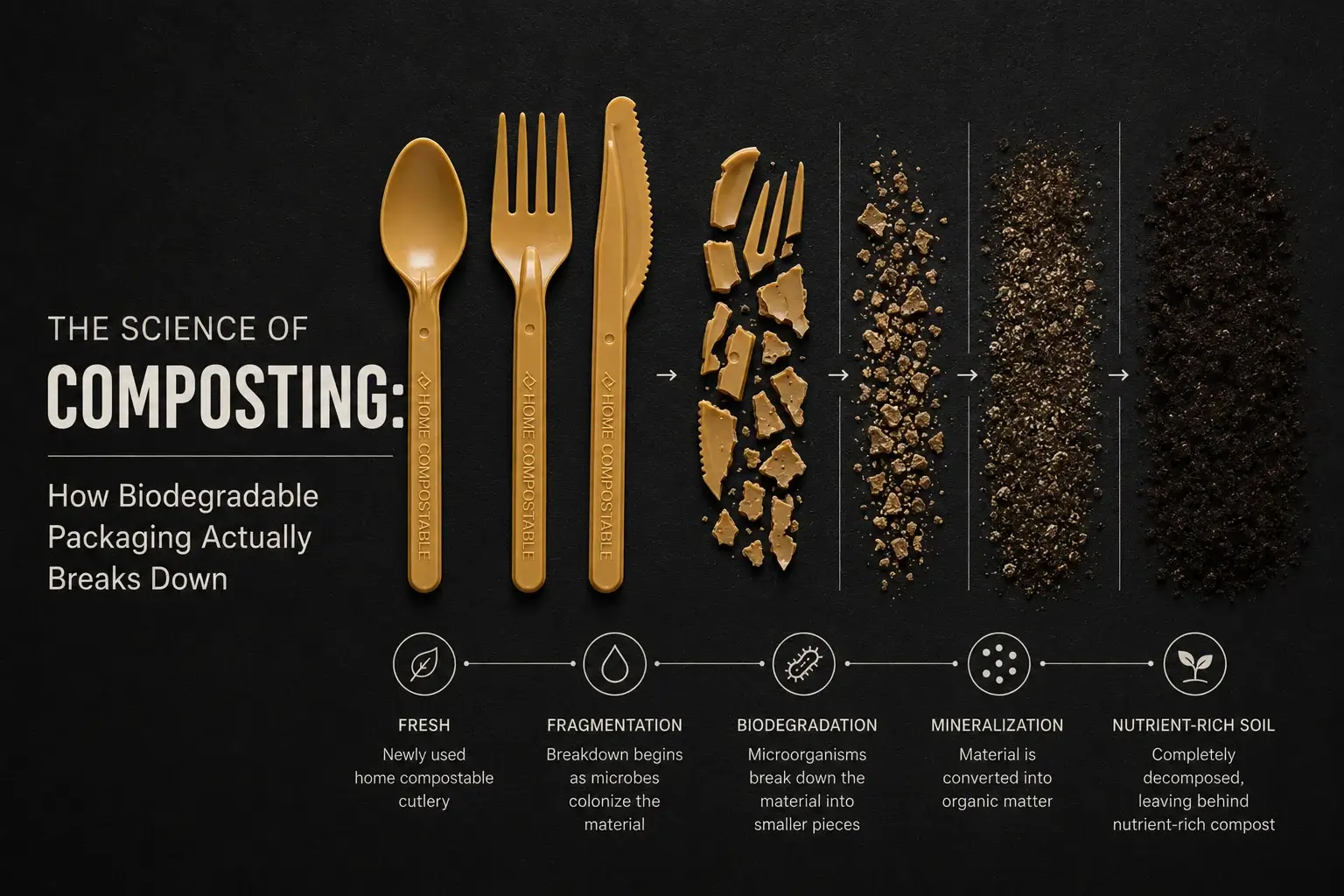
Key Advantage: Home compostable materials (OK compost HOME) provide compliance certainty without depending on recycling infrastructure.
Comparison of Pathways
- Infrastructure dependency: High (recycling facilities) | Lower (especially home compostable)
- Consumer behavior required: Sorting into recycling | Sorting into compost/green bin
- Rate targets: Must meet 30%→65% recycling | Binary: certified or not
- Material innovation: Incremental | Emerging solutions available
- Cost trajectory: Uncertain (fees may rise) | More predictable
The Compostability Option
Why Compostability May Be the Better Path
For many product categories—especially food service ware that is frequently food-soiled—compostability offers significant advantages over recyclability:
1. Food-Soiled Items Cannot Be Recycled
Cups, plates, cutlery, and containers contaminated with food residue are rejected by recycling facilities. They must either be composted or landfilled. For these items, compostability is the only viable compliance pathway.
2. Infrastructure Reality
California has more composting infrastructure than most states, but access remains limited. Home compostable materials work regardless of municipal infrastructure—they break down in backyard compost piles.
3. Compliance Certainty
Compostability is a binary certification: a material either meets the standard or it doesn't. Recyclability depends on collection rates, actual recycling rates, and market conditions—all variables outside a producer's control.
Home Compostable vs. Industrial Compostable
SB 54 accepts both home compostable and industrial compostable materials. However, they are not equivalent in practice.
- Certification: ASTM D6400/D6868 | OK compost HOME
- Temperature required: 140°F+ (60°C+) | Ambient (backyard)
- Consumer access: ~5% of population | 35%+ of households
- Facility dependency: Yes | No
- Practical outcome: Often landfilled | Actually composts
Strategic Recommendation: Home compostable materials provide more robust compliance because they function regardless of whether consumers have access to industrial composting facilities.
California's AB 1201: Labeling Requirements
California's AB 1201 (effective January 2024) regulates the use of "compostable" and "home compostable" claims:
- Products labeled "compostable" must be third-party certified (ASTM D6400, D6868, or D8410)
- Products labeled "home compostable" must meet OK compost HOME or equivalent
- Compostable products must be allowable agricultural organic input under USDA National Organic Program (NOP)—a requirement that has become highly consequential following the January 2026 NOSB vote (see "The NOSB Ruling" section below)
- Deceptive labeling carries penalties
Critical Update: The NOP organic input requirement is currently under a CalRecycle enforcement extension through June 30, 2027. The NOSB's unanimous rejection of compostable polymers means this requirement cannot be satisfied through the normal regulatory process. See the NOSB section below for full details on the implications and paths forward.
This means any material you claim as "compostable" for SB 54 compliance must have legitimate certification—and producers must closely monitor the evolving federal regulatory landscape around NOP allowability.
The NOSB Ruling: A Critical Complication for Compostable Packaging
What Happened
On January 13-14, 2026, the National Organic Standards Board (NOSB) voted unanimously (12-0, with 3 absent) against adding broad classes of synthetic compostable polymers to the National List of Allowed and Prohibited Substances. The vote rejected a proposal that would have allowed materials meeting ASTM D6400, D6868, and D8410 composting standards to be used as compost feedstocks in organic agriculture.
This vote was the culmination of a multi-year process. In August 2023, the Biodegradable Products Institute (BPI) petitioned the USDA National Organic Program (NOP) to update compost regulations to include certified compostable materials. The NOSB reviewed the petition through several meetings, commissioned a technical report, and ultimately rejected the proposal at every stage—including a 14-0 vote at the Spring 2025 meeting formalizing that all synthetic compost feedstocks must be individually evaluated through the National List process.
Why the NOSB Rejected Compostable Polymers
The NOSB cited several grounds for its unanimous rejection:
- PFAS contamination concerns. The board's commissioned technical report found a correlation between compostable packaging and PFAS contamination in finished compost, noting that "undisclosed additives, including plasticizers and PFAS, are common in compostables and may persist through composting."
- Microplastic and nanoplastic risks. The board expressed concern that micro and nanoplastics from compostable packaging could "alter soil microbial communities, weaken soil aggregation, and carry hazardous chemicals."
- Sorting impossibility at scale. Composters cannot reliably distinguish certified compostable plastics from conventional plastics on processing lines. Most composters already remove all plastic-like materials regardless of compostability claims.
- ASTM standards deemed inadequate. The board found that ASTM composting standards measure disintegration but not full biodegradation, and permit up to 10% residues without comprehensive contaminant controls.
- No demonstrated necessity. High-quality organic compost is already produced from plant and animal inputs without synthetic additions.
- Overwhelming public support for keeping synthetic compostable polymers out of organic compost.
Why This Matters for SB 54 Compliance: The AB 1201 Connection
The NOSB vote creates a cascading regulatory conflict that directly affects the compostability pathway under SB 54. The chain of consequence is as follows:
1. California's AB 1201 requires that products labeled "compostable" or "home compostable" must be "an allowable agricultural organic input under the requirements of the USDA National Organic Program (NOP)."
2. For synthetic substances, NOP allowability requires the material to be listed on the National List of Allowed and Prohibited Substances.
3. The NOSB voted unanimously against adding compostable polymers to the National List.
4. Therefore, synthetic compostable plastics—including PHA, PLA, and other bioplastics—are not currently allowable agricultural organic inputs under NOP.
5. Under the strict letter of AB 1201, these products cannot be labeled "compostable" in California.
The CalRecycle Extension: A Temporary Reprieve
Recognizing the federal regulatory uncertainty, CalRecycle extended the AB 1201 NOP compliance deadline:
- Original deadline: January 1, 2026
- Current extended deadline: June 30, 2027
- Maximum possible extension under law: January 1, 2031
CalRecycle granted the extension citing "recent and anticipated activities" of the NOSB and acknowledging that "there is no reasonable possibility that such process and subsequent formal rulemaking will conclude before January 1, 2026." Products meeting all other California compostability standards (ASTM D6400/D6868, BPI certification) can continue to bear "compostable" labels through the extension period.
However, this is a temporary measure. If the NOP issue is not resolved, the January 1, 2031 hard deadline becomes a cliff after which compostable plastic packaging may lose the legal right to be labeled "compostable" in California.
The Double Bind for Compostable Packaging Producers
The intersection of SB 54 and the NOSB ruling creates a potential regulatory dead end:
- SB 54 requires all packaging to be "recyclable or compostable" by 2032
- PHA and PLA are classified as "plastic" under SB 54, subject to source reduction requirements
- The compostability pathway requires the product to be labeled "compostable"—but AB 1201 may prohibit that label if the NOP issue remains unresolved
- Compostable plastics are generally not recyclable in conventional recycling streams
- Result: Compostable plastic packaging could potentially be classified as "plastic" but unable to qualify as either "recyclable" or "compostable" under California law
Paths Forward
Several potential resolutions are being pursued:
1. USDA Rulemaking. BPI and industry allies sent a letter to USDA in February 2026 with dozens of signatories—including Ameripen, the Foodservice Packaging Institute, Consumer Brands Association, Georgia-Pacific, and NatureWorks—urging USDA to publish an interim final rule that would update the definition of "compost" under federal organic regulations. This would bypass the NOSB National List process entirely.
2. Individual Substance Petitions. The NOSB explicitly stated it remains "open to evaluating individual substances" that may meet National List criteria. Specific PHA formulations, fruit stickers, or food scrap collection bags could be petitioned separately—though this process takes years.
3. CalRecycle Extensions. The current extension runs through June 30, 2027. CalRecycle can renew extensions while federal regulations are "under consideration," up to the January 1, 2031 maximum.
4. Legislative Amendment. California could amend AB 1201 to decouple the "compostable" labeling requirement from NOP allowability. This would require legislative action.
5. Narrower NOSB Proposals. The board indicated willingness to consider "allowing broader classes of substances with more restricted use patterns," which could open a pathway for limited categories like compostable food service ware.
What Producers Should Do Now
- Continue using certified compostable materials through the current extension period
- Monitor federal rulemaking at USDA/NOP—the outcome will determine whether the compostability pathway remains viable in California
- Develop contingency labeling strategies in case the NOP issue is not resolved by the extension deadline
- Maintain comprehensive documentation of certifications, lab testing, and third-party verifications
- Engage with industry associations (BPI, Ameripen, Foodservice Packaging Institute) that are actively advocating for resolution
- Consult legal counsel regarding AB 1201 compliance obligations and liability exposure
Producer Responsibility Organizations
What is a PRO?
A Producer Responsibility Organization (PRO) is a nonprofit entity that administers the EPR program on behalf of producers. The PRO:
- Collects fees from covered producers
- Invests in recycling and composting infrastructure
- Manages compliance reporting
- Coordinates with CalRecycle
- Distributes funds to support collection and processing
Circular Action Alliance (CAA)
Circular Action Alliance has been designated as California's inaugural PRO for SB 54. CAA is also the designated PRO for Colorado and Oregon, creating potential efficiencies for multi-state compliance.
Producer Obligations:
- Register with CAA
- Report packaging volumes by material type
- Pay producer responsibility fees
- Meet individual recycling/compostability targets
Fee Structure
PRO fees will be based on:
- Volume of covered materials sold in California
- Material type (plastic, paper, glass, metal, compostable)
- Recyclability/compostability status
- Environmental impact weighting
Key Insight: Producers using recyclable or compostable materials will likely pay lower fees than those using non-compliant materials. As targets increase, the fee differential will grow—creating a strong financial incentive to switch materials early.
Financial Implications
Cost of Compliance
The financial impact of SB 54 varies significantly based on a producer's current packaging and compliance strategy:
For Producers Already Using Compliant Materials:
- Registration and reporting costs
- PRO membership fees (likely reduced rates for compliant materials)
- Minimal material cost changes
For Producers Requiring Material Changes:
- Material cost differential (may be higher, neutral, or lower depending on switch)
- Potential equipment modifications
- Packaging redesign costs
- Transitional inventory management
For Non-Compliant Producers:
- Escalating PRO fees (designed to incentivize compliance)
- Potential market access restrictions post-2032
- Reputational risk with sustainability-conscious consumers
Cost Projections
Industry estimates suggest:
- PRO fees: $0.01-0.05 per unit for compliant materials; potentially 2-5x higher for non-compliant
- Material cost changes: Varies widely; some compostable alternatives now cost-competitive with conventional plastic
- Infrastructure investment: Shared across producers via PRO; individual investment may reduce fees
The "Drop-In" Advantage
Some compliant materials offer drop-in compatibility with existing manufacturing equipment—meaning no capital expenditure for equipment modifications. This significantly reduces the transition cost for producers.
Questions to ask potential suppliers:
- Does this material work with our existing injection molding/thermoforming equipment?
- What process modifications, if any, are required?
- What is the learning curve for production staff?
Related California Regulations
SB 54 exists within a broader California regulatory ecosystem. Producers should understand how these laws interact:
AB 1201: Compostable Labeling
- Regulates "compostable" and "home compostable" claims
- Requires third-party certification and NOP organic input allowability
- NOP requirement currently under CalRecycle extension through June 30, 2027 (maximum extension: January 1, 2031)
- Effective January 2024
- Penalties for deceptive labeling
- See "The NOSB Ruling" section for critical developments affecting this requirement
SB 1046: Plastic Bag Ban Extension
- Effective January 2025
- Grocery stores may only provide recycled paper bags or compostable bags for produce/meat
- Compostable bags must meet certification requirements
AB 793: Recycled Content Requirements
- Requires minimum recycled content in plastic beverage containers
- 15% by 2022, 25% by 2025, 50% by 2030
- Applies to CRV containers (beverages)
Proposition 65: Warning Requirements
- Requires warnings for products containing listed chemicals
- Some plastic additives may trigger requirements
- Compostable alternatives may avoid certain warnings
PFAS Restrictions
- California restricts PFAS in food packaging
- Many compostable materials are inherently PFAS-free
- Provides additional compliance benefit
Compliance Strategy Recommendations
Step 1: Audit Current Packaging Portfolio
Create a comprehensive inventory of all packaging and food service ware sold in California:
- Material types (plastic, paper, compostable, etc.)
- Volume by SKU
- Current recyclability/compostability status
- Supplier information
- Cost per unit
Step 2: Identify High-Risk Items
Flag items that:
- Are made from non-recyclable plastic
- Are food-soiled in normal use (making recycling impossible)
- Lack certification as recyclable or compostable
- Have high volume/high visibility
Prioritize these for early transition.
Step 3: Evaluate Material Alternatives
For each high-risk item, research alternatives:
Questions to Answer:
- What certified compostable options exist?
- What is the cost differential?
- Is the alternative drop-in compatible with current equipment?
- What certifications does the alternative hold?
- Can the supplier scale with our volume needs?
Step 4: Pilot and Test
Before full transition:
- Conduct pilot runs with alternative materials
- Test performance (heat resistance, durability, appearance)
- Gather customer feedback
- Verify certification documentation
- Negotiate volume pricing
Step 5: Develop Transition Timeline
Create a phased transition plan:
- Immediate: 2024-2025 | High-risk, high-volume items
- Near-term: 2025-2027 | Remaining food service items
- Medium-term: 2027-2030 | Full portfolio transition
- Final: 2030-2032 | Verify 100% compliance
Step 6: Register and Report
- Register with Circular Action Alliance
- Establish reporting systems
- Track material volumes by type
- Prepare for annual compliance reporting
Step 7: Communicate Externally
- Update packaging claims and certifications
- Train sales teams on compliance story
- Develop customer-facing sustainability messaging
- Consider certification logos on packaging
Case for Early Action
Why Move Before Deadlines?
1. Supply Chain Security
As 2032 approaches, demand for compliant materials will surge. Producers who establish supplier relationships early will have priority access; latecomers may face shortages or premium pricing.
2. Learning Curve
Material transitions involve learning curves—equipment adjustments, process optimization, quality control. Starting early allows time to refine without deadline pressure.
3. Fee Advantages
PRO fee structures will likely reward early adopters. Producers demonstrating good-faith progress toward compliance may receive favorable treatment.
4. Market Positioning
Sustainability is increasingly a competitive advantage. Brands that lead on compliance can market their environmental commitment; laggards risk negative perception.
5. Regulatory Certainty
Requirements may tighten. California has historically increased environmental standards over time. Materials compliant today will remain compliant; those on the margin may not.
The Cost of Waiting
Delaying compliance carries risks:
- Higher material costs as demand spikes near deadlines
- Limited supplier options as capacity is committed to early movers
- Rushed transitions with higher error rates
- Reputational damage from being seen as a laggard
- Regulatory penalties if deadlines are missed
Conclusion: Compliance as Opportunity
SB 54 represents a fundamental shift in how California—and eventually, other states—approach packaging sustainability. For producers, this creates both obligations and opportunities.
The obligation: Ensure all packaging sold in California is recyclable or compostable by 2032, with escalating targets along the way.
The opportunity: Lead the transition to sustainable packaging, secure supply chain advantages, reduce long-term costs, and build brand value with environmentally conscious consumers.
Home compostable materials offer a particularly compelling pathway—providing compliance certainty, infrastructure independence, and genuine environmental benefit.
The producers who act decisively now will be best positioned for the sustainable packaging economy of the next decade.
About PlantSwitch
PlantSwitch manufactures home compostable food service packaging that meets California's SB 54 requirements today. Our CompostZero™ materials are:
- OK compost HOME certified (compliant with SB 54 compostability pathway)
- Drop-in compatible with existing plastic manufacturing equipment
- Made in the USA (Sanford, North Carolina)
- Derived from agricultural waste (not food crops)
For producers seeking SB 54 compliance for food service items, PlantSwitch offers a pathway to meet requirements ahead of schedule while reducing environmental impact.
Request a compliance consultation →
Appendix: Key Definitions
Covered Material: Single-use packaging and food service ware sold in California, with specific exemptions.
Producer: Entity that manufactures, imports, sells under its brand, or licenses its brand for covered materials in California.
PRO (Producer Responsibility Organization): Nonprofit entity administering the EPR program, collecting fees, and investing in infrastructure.
Recyclable: Material collected for recycling from 60%+ of California residents with 40-60% actual recycling rate (depending on year).
Plastic (under SB 54): A synthetic or semisynthetic material chemically synthesized by the polymerization of organic substances. Explicitly includes PET, HDPE, PVC, LDPE, PP, PS, PLA, PHA, and PHB. Excludes natural rubber and naturally occurring polymers such as proteins or starches.
Compostable: Material certified to ASTM D6400, ASTM D6868, or OK compost HOME standards. Under AB 1201, must also be an allowable agricultural organic input under USDA NOP—a requirement currently under CalRecycle enforcement extension through June 30, 2027.
Source Reduction: Reducing the total amount of covered material sold through elimination of plastic packaging or shifting to reuse/refill systems. Does not include substituting one plastic for another (e.g., switching from polystyrene to PHA).
NOSB: National Organic Standards Board. Federal advisory board that recommends which substances should be allowed or prohibited in organic agriculture. Voted unanimously (12-0) in January 2026 against adding synthetic compostable polymers to the National List.
NOP: USDA National Organic Program. The federal regulatory framework governing organic agriculture, including what materials may be used in organic compost production.
References
- California Legislature, Senate Bill 54 (2022)
- California Public Resources Code, Section 42041—Definitions
- CalRecycle, Packaging EPR Program Guidelines
- California Legislature, Assembly Bill 1201 (2021)
- TÜV Austria, OK compost HOME Certification Standard
- ASTM International, D6400 and D6868 Standards
- Circular Action Alliance, Producer Registration Guidelines
- CalRecycle, Draft SB 54 Regulations (2025)
- NOSB Crops Subcommittee, Synthetic Compostable Polymers Proposal, Fall 2025 Meeting (January 13-14, 2026)
- USDA AMS, Fall 2025 Rescheduled NOSB Meeting Transcript
- USDA AMS, 2025 Limited Scope Technical Report: Compostable Materials
- CalRecycle, AB 1201 NOP Requirement Extension Letter (June 11, 2025)
- Packaging Dive, "USDA organics board rejects compostable polymers" (January 2026)
- National Law Review, "NOSB Rejects Request to Include Synthetic Polymers in Organics Compost List" (January 2026)
- BioCycle, "Organics Board Blocks Broad Inclusion of Compostable Plastics in Organic Compost" (January 2026)
- Packaging Dive, "Producers, composters renew push for federal rulemaking on compost" (February 2026)
- Perkins Coie, "California Postpones Enforcement of Compostable Packaging Standards" (2025)
- GO!PHA, Response to CalRecycle PEIR Input Request
- PMC/Bioengineering, "Microbial PolyHydroxyAlkanoate (PHA) Biopolymers—Intrinsically Natural" (2023)
Last Updated: March 2026
Disclaimer: This whitepaper provides general guidance and should not be construed as legal advice. Consult with qualified legal counsel regarding specific compliance obligations.