

The Problem with "Compostable" Packaging
Brands are under real pressure to ditch conventional plastic. Regulators are tightening rules. Customers are asking harder questions. And the logical answer — switch to compostable packaging — sounds simple enough.
But here's where it gets complicated: not all compostable packaging actually composts.
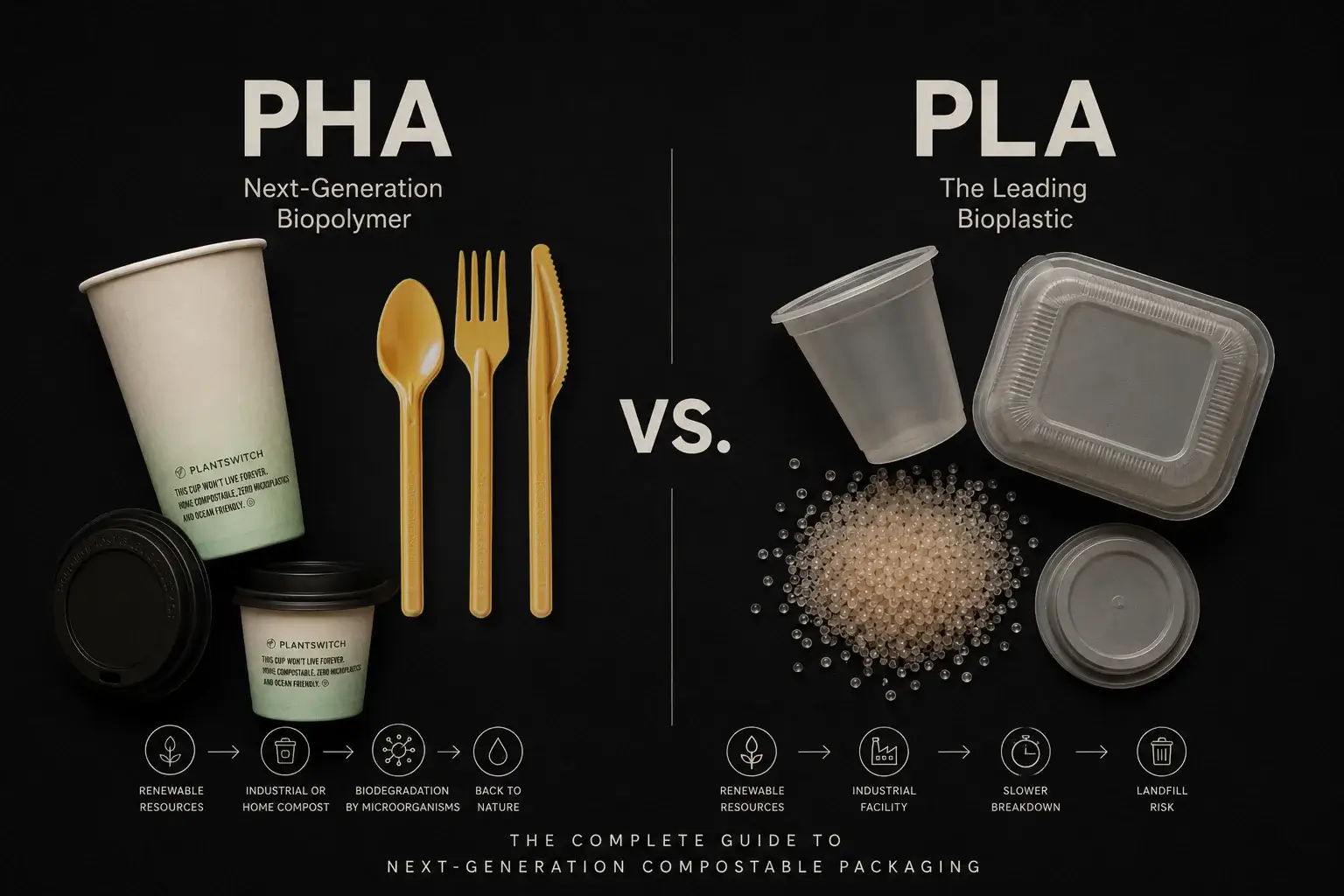
Two materials dominate the compostable packaging market right now — PLA (polylactic acid) and PHA (polyhydroxyalkanoates). Both are plant-derived. Both carry green credentials on their face. But dig one layer deeper and the differences are stark — in how they break down, where they break down, and what happens when they end up somewhere other than an industrial composting facility.
This guide covers exactly what each material is, how they compare across every dimension that matters to a procurement or sustainability decision, and why the industry is increasingly moving away from PLA toward PHA.
What Is PLA?
PLA is a bioplastic made from fermented plant starches — typically corn, sugarcane, or cassava. It was one of the first widely adopted "compostable" alternatives to petroleum-based plastic, and for over a decade it became the default material for cups, lids, cutlery, and food containers branded as eco-friendly.
PLA looks and performs similarly to conventional plastic. It's clear, rigid, and relatively inexpensive to produce. Those properties made it easy to slot into existing manufacturing lines, which drove rapid adoption.
The certification PLA typically carries is BPI (Biodegradable Products Institute), which certifies industrial compostability under ASTM D6400 standards. That distinction — industrial compostability — is the key phrase most brands glossed over for years.
To learn more about the gap between what the label says and what actually happens, read our post on why PLA isn't really compostable.
What Is PHA?
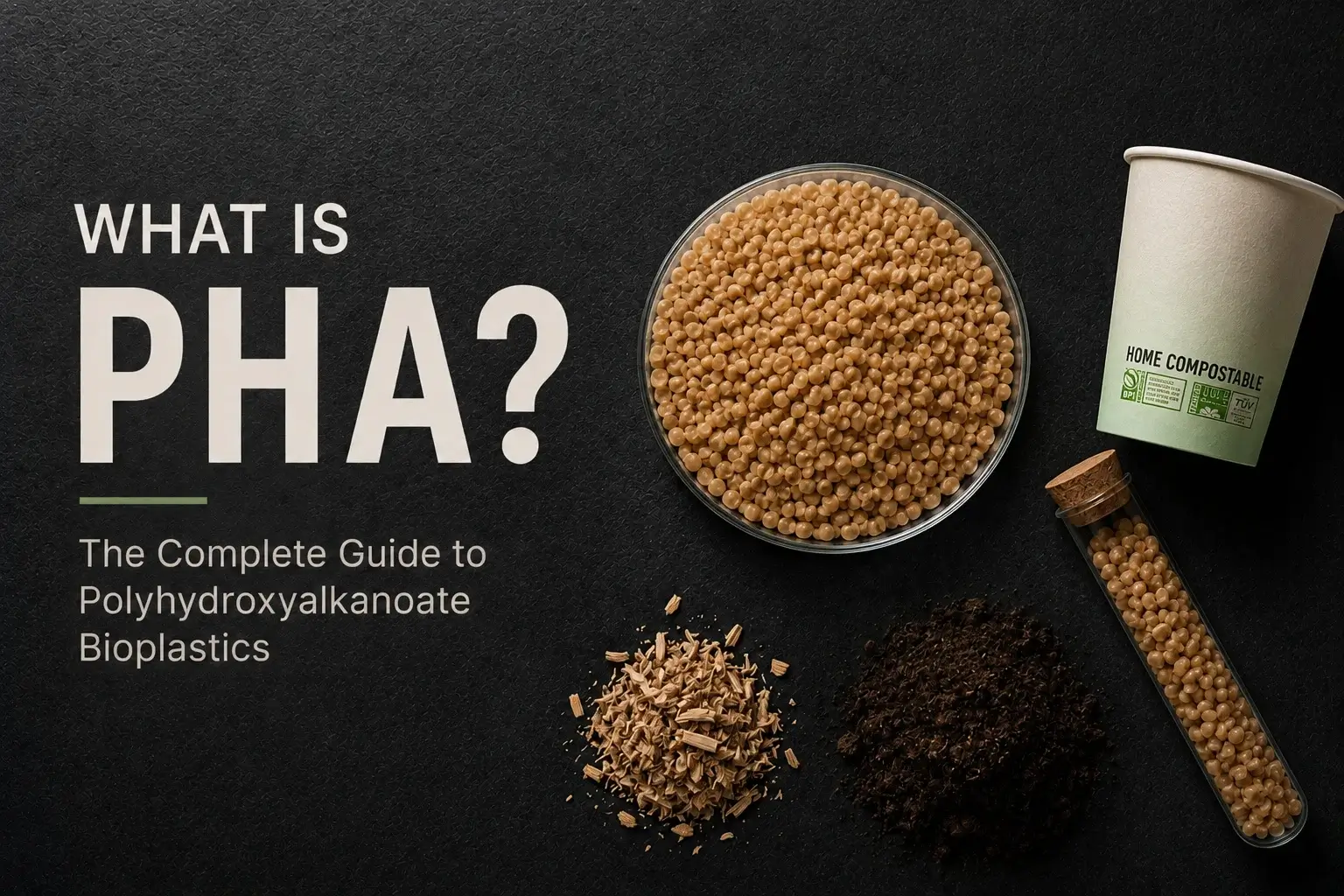
PHA (polyhydroxyalkanoates) is a family of biopolymers produced by microorganisms — bacteria that accumulate polyesters as energy storage when fed organic carbon sources. Unlike PLA, which is synthesized through an industrial chemical process, PHA is literally grown inside living cells.
The feedstocks can be remarkably sustainable. PlantSwitch, for example, produces its CompostZero™ PHA resin from upcycled agricultural waste — rice hulls and wheat straw — materials that would otherwise have no use after harvest.
What makes PHA genuinely different from every other bioplastic is how it biodegrades. Because PHA is produced by microorganisms, those same microorganisms in soil, water, and compost can recognize and break it down. No industrial facility required. No specific temperature threshold to hit. PHA biodegrades in home compost piles, in soil, and in marine environments through completely natural microbial activity.
For a deeper look at what PHA is and how it's made, see What Is PHA Bioplastics?
The Real Difference: How They Break Down
This is the section that matters most for any brand making a sourcing decision.
PLA: Industrial Conditions Only
PLA requires sustained temperatures of 136–140°F (58–60°C) to biodegrade meaningfully. Those temperatures are only reliably achieved inside industrial composting facilities, where large volumes of organic material generate significant heat during microbial processing.
What happens to PLA outside those conditions?
- Marine/freshwater environments: A peer-reviewed study published in PLOS ONE found that PLA showed no measurable degradation over 428 days in marine water conditions. That's more than a year in the ocean with essentially zero breakdown.
- Soil and home composting: Without industrial heat, PLA can persist in soil or a backyard compost pile for up to 30 years.
- Home compost bins: PLA does not meet home compostability standards. Putting PLA-labeled products in a home compost bin does not result in composting — it results in contamination.
There's also an operational reality that's reshaping the market: many commercial composting facilities are actively rejecting PLA. It's visually indistinguishable from conventional plastic. It contaminates compost streams. And it threatens the organic market access of composters whose finished product must meet strict purity standards.
PHA: Biodegrades in Any Environment
PHA biodegrades through natural microbial activity at ambient temperatures (10–42°C / 50–108°F). That means:
- Home compost: PHA biodegrades fully, typically within 7 weeks under favorable conditions.
- Soil: PHA breaks down through soil microorganisms without any special infrastructure.
- Marine and freshwater: PHA is recognized by aquatic microorganisms and biodegrades in natural water environments — the same environments where PLA shows near-zero degradation.
- Industrial composting: PHA also processes cleanly through industrial facilities.
This matters enormously for real-world impact. Packaging escapes designed end-of-life pathways constantly. A material that only biodegrades in one specific, hard-to-access environment is not a meaningful solution to plastic pollution — it's a messaging solution.
To understand why this difference exists at a molecular level, read Microplastics: PLA vs. PHA. And for a full breakdown of industrial vs. home composting requirements, see Industrial vs. Home Composting: What's the Difference?
PLA vs. PHA: Side-by-Side Comparison
FeaturePLAPHA (PlantSwitch CompostZero™)Material SourceFermented corn/sugarcane starchUpcycled agricultural waste (rice hulls, wheat straw)Composting RequirementIndustrial only (136–140°F)Home compost, soil, marine — any environmentBiodegradation TimeframeUp to 30 years outside industrial facility~7 weeks in favorable conditionsMarine BiodegradationNo degradation over 428+ daysBiodegrades via natural microbial activityMicroplastic RiskHigh — persists in environmentLow — fully metabolized by microorganismsHeat ResistancePoor — softens at 131–149°FBetter thermal stabilityCertifications AvailableBPI (industrial compost)TUV Home Compostable, BPI, Compost Alliance, USDA Certified BiobasedCA AB 1201 StatusNot compliant — excluded under USDA NOP standards as syntheticNot yet compliant — also classified as synthetic under NOSB rules, but stronger candidate for individual substance approval due to superior biodegradation profileCostLower (established at scale)Increasingly competitive as capacity scalesOne-Stop Supplier OptionLimited — fragmented supply chainYes — PlantSwitch offers cutlery, straws, stirrers, lids, cups, containers, custom OEM
Why PLA Is Losing Ground
The case against PLA isn't ideological — it's practical, regulatory, and increasingly legal.
The USDA's Unanimous Vote
In January 2026, the USDA's National Organic Standards Board voted unanimously against allowing synthetic compostable plastics — including PLA — as compost feedstock under USDA National Organic Program standards. This was the conclusion of a multi-year review process triggered by a 2023 petition from the Biodegradable Products Institute asking the USDA to formally recognize compostable plastics.
The board said no. Its reasoning: synthetic packaging doesn't belong in compost feedstocks intended for organic agriculture. This wasn't a close call — it was unanimous.
California AB 1201
California's AB 1201 requires that any product labeled "compostable" in California must qualify as an allowable agricultural organic input under USDA National Organic Program requirements — the same standards the NOSB just voted against expanding for synthetic plastics. The compliance deadline, currently set for June 30, 2027, effectively bars most compostable plastic products from carrying a "compostable" label in California.
It's important to note that this restriction applies to PHA as well as PLA. Despite being produced by microorganisms, PHA is classified as synthetic under NOSB rules, and the California Senate's analysis of AB 1201 explicitly states that neither PLA nor PHA is currently an allowable organic input. However, the NOSB has indicated it is open to evaluating individual substances on a case-by-case basis, and PHA's ability to fully biodegrade in soil, marine, and home compost environments without generating persistent microplastics makes it a meaningfully stronger candidate for future individual approval. Additionally, BPI is pursuing California legislation to decouple AB 1201 from the NOP organic input standard entirely.
For brands distributing nationally, California's regulatory framework sets the ceiling.
Composting Facilities Are Rejecting PLA
PLA's industrial composting pathway is narrowing, not widening. Facilities that accept compostable plastics are under pressure because PLA is visually indistinguishable from conventional petroleum plastic. When it contaminates a compost batch, it can destroy the organic certification of the finished compost — and cost the facility its market access. A CalRecycle survey found that 20 out of 24 California composting facilities actively screen out plastic and plastic-containing materials as contaminants.
World Centric, Eco Products, and the Distributor Shift
World Centric — long considered one of the leading PLA-based compostable foodware brands — dropped its BPI certification in early 2024 due to disputes with BPI's embossing and logo requirements. Eco Products and other PLA-focused brands have similarly fallen out of favor with major broadline distributors, who are actively looking to consolidate their entire compostable portfolio into a single, reliable, next-generation supplier.
Greenwashing Liability Is Growing
Brands that have leaned hard into "biodegradable" or "compostable" claims based on PLA are increasingly exposed to litigation. Greenwashing lawsuits tied to misleading environmental claims are accelerating globally, with regulators and plaintiffs alike scrutinizing the gap between marketing language and real-world performance. A product that doesn't biodegrade outside of an industrial facility is a liability waiting to be triggered.
For more on the legal landscape, read PLA Greenwashing Lawsuits: What Brands Need to Know.
Why PHA Is the Future of Compostable Packaging
Market Momentum
The numbers reflect where the industry is heading. PHA production capacity is projected to grow 166.7% by 2026, significantly outpacing PLA's 81.5% growth over the same period. The PHA market is projected to grow from $123.8 million in 2025 to $265.2 million by 2030, at a CAGR of 16.5%. The broader biodegradable packaging market is on track to reach $9.24 billion by 2026, with projections pointing to $58.5 billion by 2035.
This growth is being driven by regulatory tightening, distributor consolidation, and brands that got burned by PLA needing a credible alternative with a clean certification stack.
Drop-In Manufacturing Compatibility
One practical barrier to switching from conventional or PLA packaging has always been manufacturing infrastructure. PHA is increasingly compatible with standard injection molding, thermoforming, and extrusion equipment — the same lines already producing PLA and petroleum-based foodware. The switch doesn't require rebuilding a factory.
True Biodegradability, No Asterisk
PHA's biodegradation story requires no fine print. It doesn't say "compostable under industrial conditions." It doesn't say "dispose of at a certified facility." PHA biodegrades in soil, home compost, marine environments, and industrial facilities — through the same microbial pathways that break down organic matter in nature. For brands making real claims, that's the only kind of biodegradability worth claiming.
What to Look for When Choosing Compostable Packaging
If you're a procurement manager or sustainability director evaluating suppliers, here's a practical checklist to cut through the noise:
Biodegradation scope:
- Does the product biodegrade outside of industrial composting conditions?
- Is there documented degradation data for home compost, soil, and marine environments?
- What is the timeframe for biodegradation under realistic conditions?
Certifications:
- Does the product hold TUV Home Compostable certification?
- Is it USDA Certified Biobased?
- Does it comply with California AB 1201 requirements (effective 2027)?
- What ASTM standards does it meet?
Regulatory alignment:
- What is the material's status under the USDA National Organic Program? (Note: neither PHA nor PLA is currently classified as an allowable organic input, though the NOSB is open to individual substance reviews)
- Will it remain compliant as California and other states tighten compostable labeling laws?
Supply chain:
- Can the supplier cover your full compostable product range (cutlery, cups, lids, containers)?
- Are you buying from the manufacturer directly, or adding margin through a distributor?
- Is the resin proprietary and traceable, or sourced from third-party contract manufacturers?
Claims integrity:
- Have your marketing claims been reviewed for greenwashing exposure?
- Does the supplier provide documentation to support any "biodegradable" or "compostable" claim?
How PlantSwitch Solves This
PlantSwitch was built to solve the specific problem this guide outlines. While most compostable packaging companies source PLA from a handful of large resin producers and assemble products through contract manufacturers, PlantSwitch is vertically integrated — they produce their own CompostZero™ PHA resin from upcycled agricultural waste (rice hulls and wheat straw), and they manufacture finished products in-house. That means full traceability, no supply chain surprises, and the ability to work directly with customers from product spec to delivery.
PlantSwitch's products — cutlery, straws, stirrers, lids, cups, containers, and custom OEM formats — carry the full stack of certifications: TUV Home Compostable, BPI, Compost Alliance, and USDA Certified Biobased. These aren't marketing badges; they're documentation that the materials meet the most rigorous standards for real-world biodegradation, organic compatibility, and bio-based content. Every claim PlantSwitch makes is backed by third-party verification.
For distributors and food service operators looking to consolidate, PlantSwitch offers something the PLA market has never been able to provide: a single supplier that covers your entire compostable product line, from resin to finished goods, without routing through middlemen. In a market where distributors are actively trying to reduce vendor complexity, that's a meaningful structural advantage — and one that becomes more valuable as regulatory pressure on PLA increases.
The Bottom Line
PLA had a decade-long run as the default "compostable" material. That run is ending. Composting facilities are rejecting it. Regulators are closing the labeling loopholes that made it marketable. And the real-world biodegradation data — no degradation in marine water over 400 days, potential persistence in soil for decades — makes the "biodegradable" claim increasingly untenable.
PHA is what compostable packaging was supposed to be: a material that actually returns to nature, in any environment, without requiring a specialized facility or a specific temperature threshold. As production scales and costs continue to fall, there's no longer a compelling case for accepting PLA's limitations.
Ready to Make the Switch?
Request a PlantSwitch sample kit to see CompostZero™ PHA products in hand — cutlery, straws, lids, cups, and more, all certified home compostable and USDA Biobased.
Or download the PHA vs. PLA Whitepaper for a deeper technical comparison, full certification documentation, and regulatory guidance for your legal and sustainability teams.
Request a Sample Kit → | Download the Whitepaper →
Related Reading:
- Why PLA Isn't Really Compostable
- Microplastics: PLA vs. PHA
- Industrial vs. Home Composting: What's the Difference?
- PLA Greenwashing Lawsuits: What Brands Need to Know
- What Is PHA Bioplastics?