

The Window Is Closing — Are You Ready?
Here is the situation for broadline distributors right now: your customers are asking for compostable packaging at a rate you have not seen before. Regulators across seven states have enacted EPR packaging laws, with more coming. The PLA products sitting in your warehouse are about to become a liability. And your sales reps are losing deals to competitors who can answer sustainability questions you have not been trained to answer.
This is not a trend you can defer. As of 2026, seven states — Maine, Oregon, Colorado, California, Minnesota, Maryland, and Washington — have enacted comprehensive EPR packaging laws, shifting the financial burden of packaging waste management from municipalities onto the companies that manufacture, distribute, and sell packaged products. That includes distributors.
The compostable foodservice packaging market, valued at $4.2 billion in 2025, is projected to nearly double to $9.8 billion by 2035 at a CAGR of 8.8%. The distributors who own that growth will be the ones who built a credible, consolidated compostable portfolio now — not the ones scrambling to patch together a supplier list in 2027.
This guide covers everything a procurement manager at a distribution company needs to build a defensible, profitable compostable packaging program: how to evaluate suppliers, which products to stock, how to protect margins, and why portfolio consolidation is the strategic move that separates the leaders from the laggards.
Why Compostable Packaging Is No Longer Optional for Distributors
Customer Demand Is Real and Growing
Fifty-one percent of global consumers rate environmental impact as extremely or very important when evaluating packaging, according to McKinsey's 2025 Sustainable Packaging survey. More practically for distributors: the customers driving your revenue — QSRs, fast-casual chains, institutional foodservice operators — are under board-level pressure to hit sustainability targets. When a customer calls asking for certified compostable cutlery, a straw that meets home composting standards, or a lid that passes AB 1201, they are not making a special request. They are executing a procurement mandate.
Products making sustainability-related claims have averaged 28% cumulative growth over five years compared to 20% for products with no such claims, according to a McKinsey and NielsenIQ study. Your customers are selling to consumers who respond to those claims. That creates pull-through demand you can own — or let a competitor own.
The Regulatory Pressure Is Coming for Your Inventory
The regulatory landscape is not stable. California's AB 1201 requires that products labeled "compostable" must qualify as an allowable agricultural organic input under the USDA National Organic Program, with a compliance deadline of June 30, 2027. The USDA's National Organic Standards Board voted unanimously (12-0) in January 2026 against allowing synthetic compostable plastics as organic inputs — which has created significant uncertainty about which products will still be legally "compostable" in California in two years.
For distributors, this is a hard inventory question: what SKUs do you currently stock that will be non-compliant or delisted in California by mid-2027? Do you have a replacement strategy? If not, that product line becomes a write-down risk and a customer retention problem.
EPR laws add another layer. Under most state EPR frameworks, if a brand owner cannot be identified, responsibility can fall to the importer or distributor. That is not an abstract risk for broadline distributors who stock private-label or import-sourced packaging.
Competitive Positioning: The First-Mover Window
Not every distributor has a polished compostable packaging offering. Most have a hodgepodge: a few BPI-certified SKUs from one vendor, some PLA cups from another, unclear certification stacks, and sales reps who change the subject when certification questions come up. The distributors who close that gap in the next 12 months will be materially harder to displace from the customer relationships they capture.
The Distributor's Dilemma: Vendor Sprawl vs. Portfolio Control
Most distributors sourcing compostable packaging today are buying from three to six different vendors across the product categories they need — cutlery from one source, straws from another, cups and lids from a third, containers and clamshells somewhere else. This is not a deliberate strategy. It is the result of adding vendors reactively as customer requests came in.
The operational cost of that vendor sprawl is real:
- Multiple price negotiations with inconsistent MOQ structures
- Fragmented certification documentation — different cert standards, different third parties, different renewal timelines
- Inconsistent quality and lead times across product categories
- No consolidated account manager who understands your full compostable program
- Inventory risk diversified across too many SKUs from too many sources
The problem is compounded by the certification landscape. A product needs BPI certification for mainstream foodservice acceptance, TUV Home Compostable for operators making home-compost claims, USDA Certified Biobased for procurement programs that require it, and soon, AB 1201 compliance for California. Very few suppliers carry all four. When you are sourcing from multiple vendors, you are almost certainly managing gaps in your certification coverage.
The solution — increasingly being adopted by the largest broadline distributors — is portfolio consolidation around one or two anchor suppliers who can cover the full compostable SKU range with consistent certifications and a single point of accountability. The question is how to identify and qualify that supplier.
How to Evaluate Compostable Packaging Suppliers
Not all compostable packaging suppliers are created equal. A supplier evaluation framework for this category should cover five core dimensions:
1. Certification Stack
This is the non-negotiable first filter. The minimum acceptable certification for any product you are selling as "compostable" is BPI (Biodegradable Products Institute) certification under ASTM D6400 standards. But BPI alone is increasingly insufficient. AB 1201 compliance in California requires alignment with NOP organic input standards. Home composting claims require TUV OK Compost Home certification. And USDA Certified Biobased provides documentation of bio-based content that matters to procurement teams with sustainability mandates.
Ask every supplier: which of these certifications does your entire product line carry? A supplier who is certified on some SKUs but not others creates compliance gaps in your portfolio. A supplier who cannot clearly explain how their certifications map to California regulatory requirements is a liability.
2. Vertical Integration and Manufacturing Control
The most important supply chain risk in compostable packaging is not price — it is consistency. PLA-based products in particular have suffered from supply disruptions because most branded "compostable" companies are not manufacturers. They are sourcing PLA resin from a small number of large producers (primarily NatureWorks in the US), having products contract-manufactured overseas, and applying a brand label. When there is a resin shortage, a logistics disruption, or a quality issue at the contract manufacturer, your customer's supply chain breaks.
A vertically integrated supplier — one that controls both resin production and finished goods manufacturing — is fundamentally different. They can provide traceability from feedstock to finished product, adjust production schedules to your demand patterns, and absorb supply shocks that would stop a non-integrated brand cold.
Ask suppliers: do you manufacture your own resin? Do you operate your own production facilities or contract out manufacturing? Can you provide full traceability documentation from raw material to finished goods? The answers will quickly distinguish real manufacturers from brand-layer intermediaries.
3. Product Breadth and Portfolio Completeness
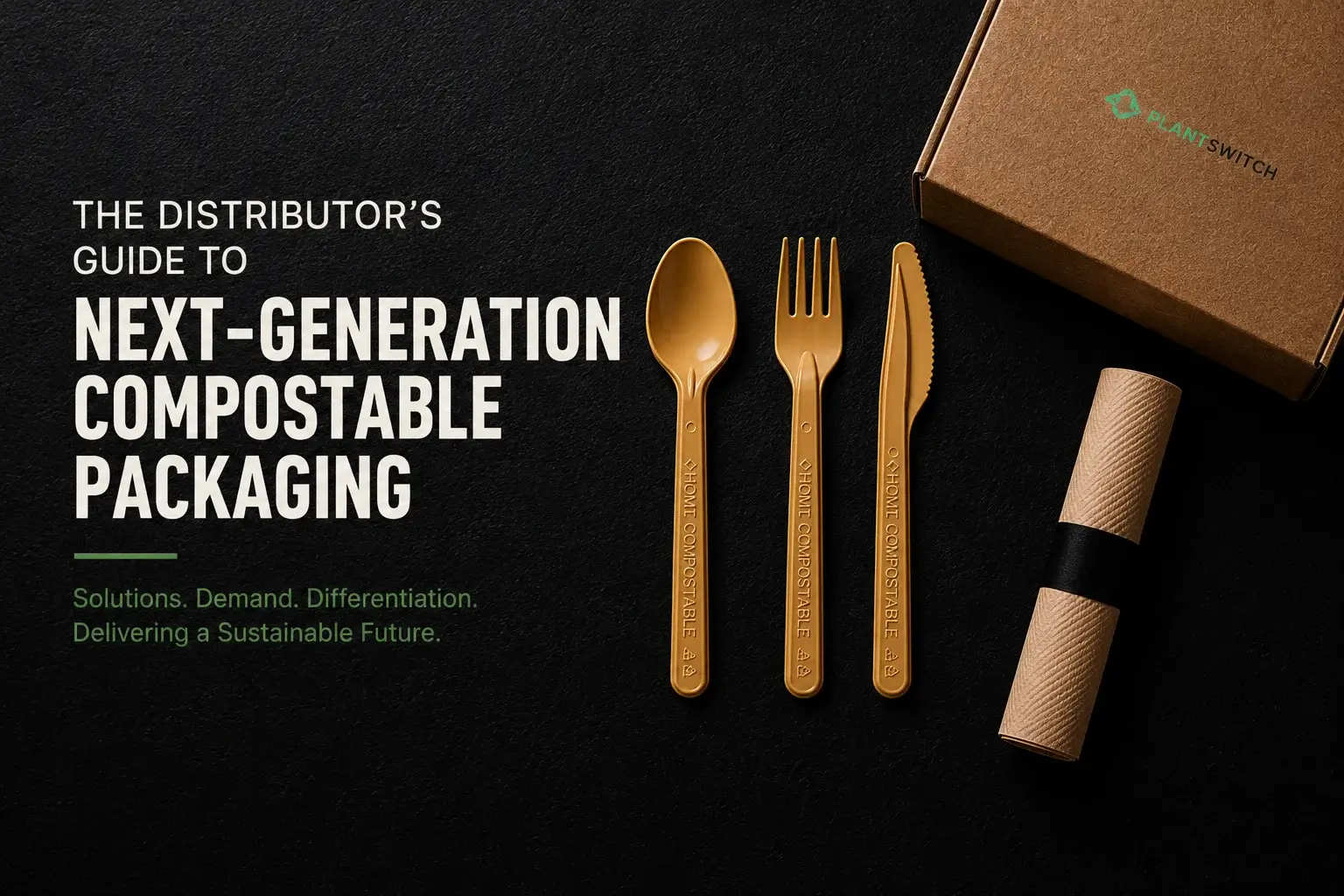
If your goal is portfolio consolidation — and it should be — your anchor compostable supplier must be able to cover your full SKU requirements across product categories: cutlery (forks, knives, spoons, sporks, kits), straws and stirrers, lids, cups, food containers, and clamshells. An anchor supplier who can only serve two or three categories forces you to maintain the vendor sprawl you were trying to eliminate.
Map your current compostable SKU requirements against each supplier's product catalog before engaging in any serious negotiation. The shortlist of suppliers who can actually cover your full range will be shorter than you expect.
4. Material: PHA vs. PLA
The material choice is not cosmetic — it determines which customers you can serve, which claims you can support, and whether your inventory will be compliant in regulated markets in 2027 and beyond. See our full breakdown at PHA vs. PLA: The Definitive Guide, but the short version for distributors is this:
PLA requires industrial composting at 136–140°F to biodegrade meaningfully. A peer-reviewed study found PLA showed no measurable degradation over 428 days in marine conditions. Twenty of 24 California composting facilities actively screen out PLA. The USDA NOSB vote against synthetic compostable plastics creates material uncertainty about PLA's future as a "compostable" labeled product in California.
PHA biodegrades in home compost, soil, marine environments, and industrial composting facilities at ambient temperatures — no industrial heat required. It carries the full certification stack (TUV Home Compostable, BPI, Compost Alliance, USDA Certified Biobased). While PHA, like PLA, is currently classified as synthetic under NOSB rules and faces the same AB 1201 organic input challenge, its superior biodegradation profile — full breakdown without persistent microplastics across all environments — makes it the strongest candidate for individual substance approval if the NOSB evaluates materials case-by-case. For distributors building a forward-looking compostable program, PHA is the safer inventory bet.
5. Pricing Transparency and Volume Economics
Compostable packaging does carry a price premium over conventional plastics — typically in the range of 20–40% depending on product category and volume. That premium is real and needs to be passed through to your customers with a clear value justification (regulatory compliance, sustainability claims, end-of-life credibility). What you want from a supplier is predictable, transparent pricing with clearly defined volume breakpoints, not opaque cost structures that shift with every order.
Ask for a published price schedule with MOQ tiers. Ask how pricing is affected by raw material cost changes. Ask whether there are long-term supply agreements available. A supplier who cannot answer these questions with specifics is not ready for a serious distribution partnership.
Supplier Evaluation Scorecard
Use this scorecard to evaluate and compare compostable packaging suppliers against your distribution requirements:
Evaluation DimensionKey Questions to AskWeightPlantSwitchCertification StackBPI? TUV Home Compostable? USDA Biobased? CA AB 1201 aligned?High✓ All fourVertical IntegrationManufactures own resin? Owns production facilities?High✓ YesProduct BreadthCovers cutlery, straws, lids, cups, containers, OEM?High✓ Full lineMaterial SciencePHA or PLA? Home compostable? Marine biodegradable?High✓ PHA onlyTraceabilityFeedstock origin documented? Batch-level quality control?Medium-High✓ YesPrice TransparencyPublished MOQ tiers? Stable pricing logic?Medium✓ YesSPIF/Co-MarketingActive SPIF programs for distributor reps? Marketing support?Medium✓ ActivePrivate Label CapabilityCustom branding available? Tooling ownership?Medium✓ OEM availableRegulatory ReadinessProactive on AB 1201, EPR, NOSB developments?High✓ YesCommunication QualityDedicated account manager? Responsive to technical questions?High✓ Yes
Understanding the PLA Regulatory Cliff
Every distributor with PLA products in their portfolio needs to understand the specific risk they are carrying.
World Centric — one of the most prominent PLA-based compostable foodware brands for years — dropped its BPI certification in early 2024 following a dispute over BPI's logo and embossing requirements. Eco Products and other PLA-focused brands have faced similar customer scrutiny. Major broadline distributors who built their compostable programs around these brands are now navigating a complicated transition.
The regulatory picture makes the transition more urgent. California's AB 1201 compliance deadline of June 30, 2027 means distributors selling into California have roughly 15 months to either confirm their current PLA SKUs will be compliant or replace them. Given that USDA rulemaking timelines are uncertain and the NOSB has already voted against synthetic compostable plastics, waiting to see how the regulatory process resolves before planning the transition is a high-risk posture.
The practical guidance: audit your compostable portfolio now against California's AB 1201 requirements. Identify which SKUs are at risk. Build a transition timeline that assumes PLA's "compostable" labeling status in California becomes non-viable by mid-2027. The distributors who start that transition now will have an orderly, customer-retention-positive experience. The ones who wait will be making emergency substitutions under deadline pressure.
For a deeper look at the regulatory landscape, see The Complete Guide to California SB 54 Compliance.
Margin and Profitability: The Real Numbers
The conventional wisdom that compostable packaging "hurts margins" is wrong. It is the wrong framework. The right question is: what does a well-structured compostable product line do to your overall account profitability?
Here is the reality in practice:
The premium is real. Compostable packaging products typically carry a 20–40% price premium over conventional plastic equivalents at the operator level. That premium flows through to distributor margin if you are sourcing directly from a manufacturer rather than through a brand intermediary.
Customers who buy compostable are stickier. A customer who has worked through the process of switching to certified compostable products — with your help — is not going to switch distributors easily. The operational switching cost (requalifying products, retraining staff, updating sustainability reporting) makes your relationship more durable.
Consolidation creates margin leverage. If you are sourcing compostable products from five vendors and consolidating to one, you are eliminating the transactional friction from four supplier relationships and concentrating volume with a single partner. Concentrated volume creates the conditions for better pricing, better terms, and dedicated service. That is a margin improvement, not a margin cost.
Private label amplifies the economics further. A distributor running a private-label compostable line (see the section below) captures full brand margin on certified products — pricing is entirely in your control, and the product builds your brand equity, not a third-party supplier's.
The key principle: treat your compostable portfolio as a premium category with category management logic, not as a specialty niche you add on the side. Set pricing that reflects the value delivered (compliance, certified claims, end-of-life credibility) and communicate that value clearly to your customers.
Helping Your Customers Make the Switch
Distributors who do the customer education work will win the accounts. Most foodservice operators are not experts in composting certifications, material science, or California regulatory requirements. They need a distributor who can simplify the decision.
Here is a framework for customer conversations:
Lead with the business case, not the environment. Frame compostable packaging as a risk management and customer experience decision first. What happens if a major customer — a hospital, a university, a QSR chain — specifies certified compostable packaging and your operator cannot supply it? What is the reputational and liability exposure from selling products labeled "compostable" that fail to biodegrade? Those are business conversations, not sustainability lectures.
Explain the certification hierarchy. Most customers do not know the difference between BPI-certified and TUV Home Compostable. A one-page explainer (which you can get from a good supplier) that maps certification to end-of-life claim is enormously useful. Customers who understand why a TUV Home Compostable product is superior to a BPI-industrial-only product will pay the premium.
Address the disposal infrastructure question directly. The most common objection to compostable packaging is "we don't have composting infrastructure." The response: home compostable PHA products biodegrade in backyard compost, soil, and even marine environments — the disposal claim does not depend on industrial composting infrastructure. That removes the objection for most operators outside major metro markets.
Provide transition support. Offer a sample kit covering the full compostable line before asking for commitment. A customer who has handled the product, tested it in service, and confirmed it works in their operation is dramatically more likely to convert — and to buy at volume.
Private Label Opportunities in Compostable Packaging
Private label in compostable packaging is a meaningful revenue and margin opportunity that most distributors have not fully explored.
Here is the case: a distributor running their own branded compostable line — their logo, their product name, their SKU numbering — on certified PHA products is building brand equity in a category that is growing at 8–9% per year. The products carry premium pricing that the distributor controls. The supplier relationship is supplier-to-distributor, not brand-to-distributor, which means margin is not being split with a brand intermediary.
The practical requirements for private label in compostable packaging:
- Full-line OEM capability from the supplier — they need to be able to produce your branded SKUs across the full product range
- Certification transfer — certifications (BPI, TUV) need to be available for private-label products; confirm this with the supplier before proceeding
- Consistent quality at volume — private label puts your name on the product; quality consistency is non-negotiable
- MOQ and lead time requirements that work at your volume levels — most private-label programs require container-scale purchasing to make the economics work
A vertically integrated manufacturer with OEM capability is the right partner for a private-label program. They control the resin, the manufacturing process, and the quality systems — which means the product consistency your brand depends on is in their control, not subject to the variability of a contract manufacturer.
Logistics and Storage: What Distributors Need to Know
Compostable packaging has real differences from conventional plastic in how it needs to be handled across the supply chain. These are not obstacles — but ignoring them creates inventory problems.
Shelf life. PHA-based compostable packaging has a standard shelf life of 10–12 months from date of manufacture under proper storage conditions. This is different from conventional plastic, which has effectively indefinite shelf life. Distributors need to manage compostable SKUs with FIFO (first-in, first-out) inventory discipline and confirm production dates with suppliers at time of order.
Storage conditions. Compostable materials degrade faster when exposed to heat, direct sunlight, or high humidity. Ideal storage conditions are a cool (17–25°C / 63–77°F), dry, low-humidity environment away from direct light. Most distribution warehouses meet these conditions — but operators with warm, humid storage areas or who are storing product outdoors (even temporarily) need to account for accelerated degradation.
Temperature sensitivity in transit. For PLA products specifically, heat sensitivity is a concern — PLA softens at relatively low temperatures (~131°F/55°C), which can cause product deformation in a hot truck or warehouse during summer months. PHA has better thermal stability. This is a relevant product performance consideration when sourcing.
Labeling and segregation. Compostable products need clear visual differentiation from conventional plastic SKUs in your warehouse to prevent mixing. Work with your supplier on clear labeling protocols, and train warehouse staff on the difference. A mislabeled compostable product going to an operator who certifies their waste stream as compostable is a liability for everyone in the chain.
SPIF Programs: Accelerating Sales Rep Performance on Compostable Lines
SPIF programs (Sales Performance Incentive Funds) are a proven mechanism for accelerating adoption of new product lines through a distributor's sales force. For compostable packaging, they are particularly valuable — because the sales conversation requires more education and consultative selling than a standard commodity transaction, and reps need a reason to invest that time.
How SPIF programs work in compostable packaging distribution:
A manufacturer or supplier provides incremental cash bonuses to a distributor's sales representatives for selling specified products within a defined timeframe. The incentive is in addition to normal sales commissions — it is designed to shift rep attention to a priority product line. SPIFs can be structured per unit, per case, or per new account converted, depending on the manufacturer's objective.
PlantSwitch is already running active SPIF programs with distribution partners including Imperial Dade — one of North America's largest broadline foodservice distributors. The structure is straightforward: reps earn per-case bonuses for PlantSwitch compostable product sales within a defined program period, with leaderboards and periodic incentive payouts to maintain engagement.
For a distributor evaluating suppliers, SPIF availability is a meaningful signal. A manufacturer running an active SPIF program has committed to investing in your sales team's performance. They are not just supplying product — they are treating your reps as an extension of their sales force, which aligns incentives in the right direction.
Questions to ask suppliers about SPIF programs:
- Is a SPIF currently available on your compostable line?
- What is the per-unit or per-case incentive structure?
- How are payouts tracked and disbursed?
- Is there a co-marketing component (sales collateral, training materials, samples)?
- What is the program duration and renewal track record?
Compostable Portfolio Checklist for Distributors
Use this checklist to audit your current compostable portfolio and identify gaps before they become customer or regulatory problems:
Certifications - [ ] Every compostable SKU in your catalog carries BPI certification (ASTM D6400) - [ ] Home compostable claims are backed by TUV OK Compost Home certification (not just BPI) - [ ] USDA Certified Biobased documentation is available for procurement teams requiring it - [ ] California AB 1201 compliance status has been confirmed for all SKUs sold into CA - [ ] PFAS-free documentation is available (required under AB 1201 for "compostable" labeling)
Material - [ ] You know whether each SKU in your compostable line is PLA or PHA - [ ] PLA exposure in CA-sold SKUs has been assessed against the June 2027 AB 1201 deadline - [ ] Home composting claims are backed by a material that actually home-composts (PHA, not PLA)
Product Coverage - [ ] Compostable cutlery (forks, knives, spoons, sporks, kits) — at least one certified SKU per item - [ ] Compostable straws and stirrers - [ ] Compostable cups (hot and cold configurations) - [ ] Compostable lids - [ ] Compostable food containers and clamshells - [ ] Custom/OEM option available for private-label program
Supplier Relationships - [ ] No more than two primary suppliers covering your full compostable range (consolidation target) - [ ] At least one supplier is vertically integrated (owns resin and manufacturing) - [ ] SPIF program is active with at least one compostable supplier - [ ] Private label capability confirmed with primary supplier
Inventory Management - [ ] FIFO inventory management is in place for all compostable SKUs - [ ] Production dates are confirmed at time of order - [ ] Warehouse storage conditions (temperature, humidity) have been confirmed compliant - [ ] Staff is trained on compostable vs. conventional plastic identification and segregation
Customer Education - [ ] Sales reps have a one-page certification explainer to use in customer conversations - [ ] Sample kits are available for customer trials before full conversion - [ ] Transition timeline guidance is available for customers migrating from conventional to compostable
Why PlantSwitch Is Built for Distributor Partnerships
Most compostable packaging companies are not manufacturers — they are brand-layer intermediaries sourcing PLA resin from a handful of large suppliers, having products made in contract facilities, and marking up on the way through. That model works until there is a supply disruption, a regulatory change, or a quality inconsistency at the contract manufacturer. Then it stops working, and you are the one explaining the situation to your customer.
PlantSwitch is structurally different. It is vertically integrated: they produce their own CompostZero™ PHA resin from upcycled agricultural waste (rice hulls and wheat straw) and manufacture finished products in their own facilities. That means full traceability, consistent quality, and no third-party supply chain variables between the raw material and the product you are stocking.
The product line covers the full distributor range: cutlery, straws, stirrers, lids, cups, food containers, clamshells, and custom OEM. The certification stack is comprehensive: TUV Home Compostable, BPI, Compost Alliance, and USDA Certified Biobased. Every product biodegrades in home compost, soil, and marine environments — no industrial composting infrastructure required for the claim to hold.
For distributors specifically, PlantSwitch offers what this guide has outlined: portfolio consolidation into a single PHA supplier with the full certification stack, active SPIF programs for your sales force, private-label OEM capability, and a regulatory posture that is aligned with where California and the broader landscape is heading — not scrambling to catch up.
The PLA era in compostable packaging distribution is ending. The distributors who recognize that and act now will be the ones their customers come to first when the regulatory pressure intensifies. Read more about the PLA-to-PHA transition at Why PLA Isn't Really Compostable and PHA vs. PLA: The Definitive Guide.
The Bottom Line
Compostable packaging is no longer a niche add-on category for forward-thinking distributors. It is becoming a core requirement: driven by customer sustainability mandates, state EPR laws expanding across seven states and counting, and a regulatory trajectory that is putting PLA-labeled "compostable" products at real risk in major markets.
The distributors who win in this environment will be the ones who build a consolidated, certified, PHA-forward compostable program now — with a supplier partner who can cover the full product range, support their sales team with SPIF programs and co-marketing, and deliver the traceability and regulatory alignment their customers need.
That is not a complicated strategy. It requires auditing your current portfolio, identifying the gaps, and choosing the right anchor supplier to fill them. The checklist in this guide gives you the starting point. The window for first-mover advantage is open — but it will not stay that way.
Ready to Build Your Compostable Program?
Request a PlantSwitch distributor sample kit — the full line of CompostZero™ PHA products, including cutlery, straws, lids, cups, and containers, all certified home compostable and USDA Biobased. See what portfolio consolidation looks like in practice.
Or download the Distributor Partnership Guide for SPIF program details, private-label program requirements, pricing tiers, and the PlantSwitch distributor onboarding process.
Request a Distributor Sample Kit → | Download the Partnership Guide →
Contact the PlantSwitch distribution team directly: sales@plantswitch.com | 949-290-9418
Related Reading: - PHA vs. PLA: The Definitive Guide to Choosing Compostable Packaging - Why PLA Isn't Really Compostable - The Complete Guide to California SB 54 EPR Compliance - Compostable Packaging ROI: The Real Numbers - What Is PHA Bioplastics? - PLA Greenwashing Lawsuits: What Brands Need to Know